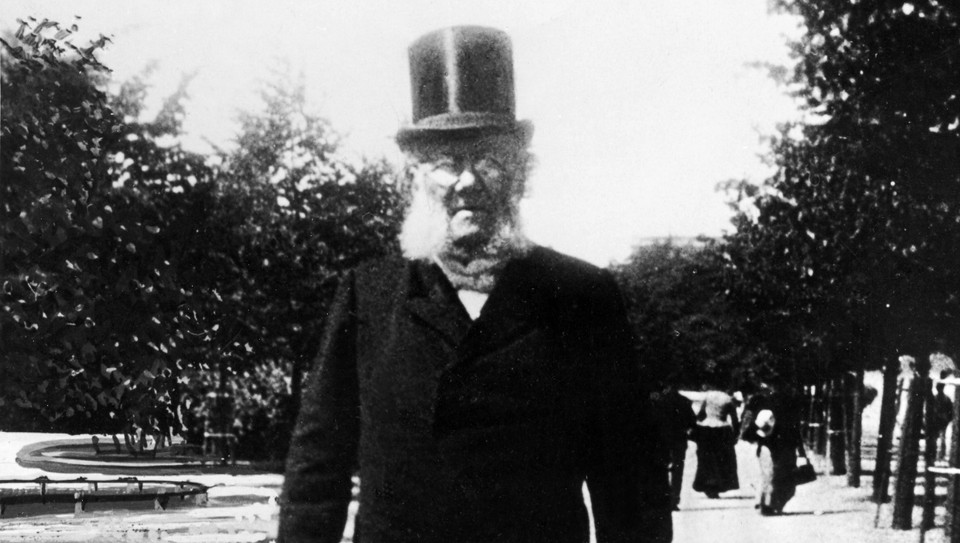
Henrik Ibsen in Grimstad
Henrik Ibsen (1828–1906) grew up in an upper-class family in Skien. After his confirmation, he was expected to attend a Latin school in accordance with his social standing, but the economic downturn in Skien left his father, Knud Ibsen, in financial difficulties. Knud Ibsen had to find a way for his son to earn his own living. A position as a pharmacy apprentice was available in Grimstad, where Henrik Ibsen began in the fall of 1843 or early 1844. He traveled to Grimstad aboard the cargo ship “Lykkens Prøve,” wearing his confirmation clothes and carrying a trunk of books as luggage.
Apprentice at Reimann
Ibsen served his apprenticeship at Jens Arup Reimann’s pharmacy. In a letter home to a friend, Ibsen reveals that he had developed an interest in poetry and drama at an early age. In the letter, he also mentions his lack of interest in pharmacy. Nevertheless, he was given significant responsibility at the pharmacy and gained increasing expertise in the field. Oral sources indicate that Ibsen had a limited social life, but that he could join in games and pranks. On Sundays, he went for walks in the moors around Grimstad, or he walked to Fjære Church. On these walks, he could read and paint. The pharmacist’s house was decorated with Ibsen’s drawings and paintings.
The pharmacy was a busy place. Ibsen even had to get up at night to serve customers. Much later, one of the maids in the house was asked what pharmacist Reimann himself spent his time doing. She replied that “he mostly went for walks.” Reimann had to sell the pharmacy in the fall of 1846. From that same fall, there is a letter to the town magistrate in which Henrik Ibsen acknowledges paternity of Hans Jacob Hendrichsen Birkedalen, the son of Reimann’s other maid, Else Sophie Birkedalen. Henrik Ibsen paid child support until Hans Jacob was 14 years old, without having any contact with his son.
Assistant to Lars Nielsen
In early 1847, Ibsen passed an examination administered by the district physician in Arendal. When Lars Nielsen took over the Grimstad Pharmacy at the same time, Ibsen was hired as a paid assistant. The pharmacy had by then moved to the location where the Ibsen Museum in Grimstad stands today. During this period, Ibsen made several friends who shared his interests. One of these friends was Christopher Due, who later wrote a memoir recounting how Ibsen became the social center of lively gatherings in the pharmacy’s break room. Both Due and Ole Carelius Schulerud took an interest in Ibsen’s writing and supported him in his efforts to get his texts published. According to Due, Ibsen was infatuated with several girls in Grimstad. Ibsen also wrote poems that he dedicated to young girls in the town.
Ibsen is said to have had a cordial relationship with the pharmacist Nielsen, but is nevertheless said to have called him “the beast.” Ibsen drew caricatures and wrote humorous poems about the townspeople, and had a receptive audience in the guardroom. Ibsen later wrote about this: “In short, while a great storm raged outside, I found myself at war with the small community where I was trapped by the conditions of life and circumstances.”
Poetry
The turbulent times outside were those of 1848, the year of revolution. Uprisings broke out in Sicily, then in France, Germany, and Austria-Hungary. The political unrest would have a profound impact on Ibsen. He wrote poems calling for freedom in Hungary and battle poems for Denmark during the First Schleswig War. The theme of rebellion is central to Ibsen’s Grimstad poetry. He received private tutoring in preparation for the artium exam so that he could become a university student. The Latin curriculum included, among other things, Sallust’s historical work on the Roman rebel and politician Catiline and Cicero’s four speeches against Catiline. Ibsen used this historical figure in his play *Catilina*, written in the winter of 1848–49. The play was published in book form on April 12, 1850, at the same time Ibsen left Grimstad. Ibsen expressed a desire to visit Grimstad again, but it never happened.
In 1862, Ibsen published the poem “Terje Vigen,” in which he drew the geographical names from the Grimstad area. And in *Samfundets Støtter*(The Pillars of Society) from 1877, Ibsen is clearly inspired by the Grimstad community. Consul Bernick in the play has much in common with the shipyard owner and shipowner Morten Smith Petersen in Grimstad. In the same play, we read about a sensational entourage strolling through the streets: “Look, look, there come all the idlers out of the pharmacy, staring at them and making their remarks.”
By Olav Haugsevje, Ibsen Museum in Grimstad