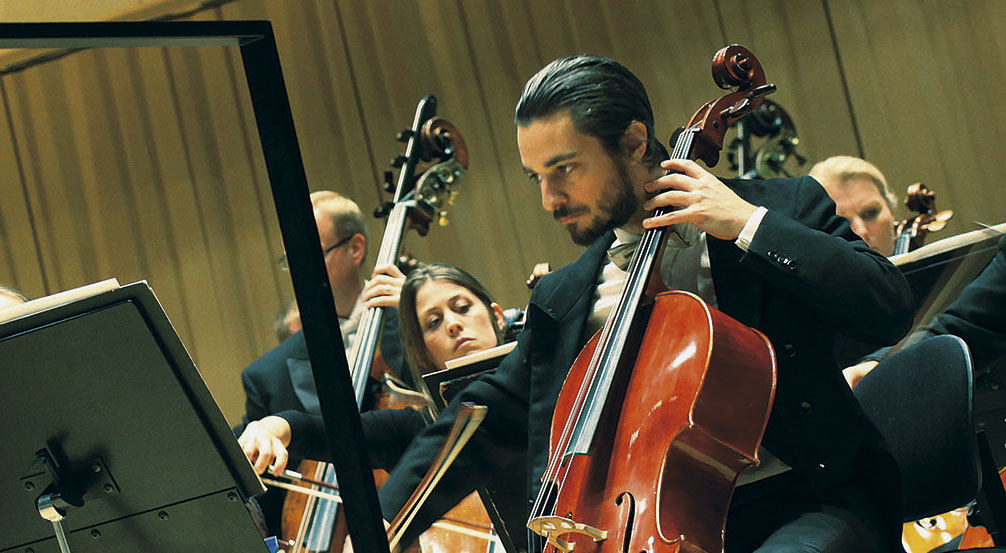
BEHIND THE SCENES WITH LEONARDO SESENNA
[ultimate_spacer height=»60″ height_on_tabs=»40″ height_on_mob=»40″]Solocellist Leonardo Sesenna (33) vokste opp på vingård i Guiseppe Verdis hjemby Busseto. Nå starter han dagen under furukronene på Gimlekollen.
- It's not that different, really. After we've finished the day's tests in Kilden, I often choose to walk home instead of taking the bus, and just enjoy the scenery," says Leonardo Sesenna, comparing it to the tranquillity he feels when he's at home on his father's vineyard in Italy. He has always found the need for relaxation at home on the farm, between the vines in Busseto - now he seeks the same closeness to nature during walks on Odderøya.
Sesenna is one of two permanent solo cellists in Kristiansand Symphony Orchestra, and has been since February 2015. The audition took place back in June 2014, after which he was selected as one of two cellists that the orchestra wanted to try out. In November, he was told that it was Leonardo KSO wanted.
- Then I came from the ensemble of the symphony in Kuopio, which is in the middle of Finland.
Before that, he played in orchestras and ensembles in Italy, Tampere and London, including for the BBC. He has studied under great cellists such as American Marianne Chen and Russian Natalia Gutman. He has studied in cities such as Florence and Modena. He has now experienced all four seasons in southern Norway and is in the process of becoming acclimatized to Kristiansand.
- "It's fantastic to live here on the coast. I'm finally doing it," he says.
Leonardo says that the seeds of his career as a cellist probably have a lot to do with his mother.
- "My mother is originally from Hungary. She played the violin and could probably have been a professional musician. Every time she played the high notes, I screamed and shouted and covered my ears. I was only eighteen months old when I first put my index finger right on the cellos and double bass at a televised concert. "There." I obviously liked the dark tones better," says Leonardo, with a smile. Today, the cello is as important to him as if it were an arm on his body.
Eventually, he started taking cello lessons - and singing in a choir. From the age of eight or nine until he was fourteen, he was a singer in a children's choir in Piacenza, the neighboring town.
- We traveled all over Europe giving concerts, just the conductor and us kids. In buses.
It wasn't unusual for the whole choir to be on tour for days on end, both in Germany and France. Without parents.
- The maestro kept us in check with military discipline. It was a strict regime, up at eight in the morning for breakfast and the first exercises. Then it was off to dinner, and in the evenings there was football training and social activities.
"It was during these years that Leonardo developed a symbiotic relationship with music and creating music together with others," he says. "It was a preparation for life as a musician in a symphony orchestra, where you have to expect to move around the world to make a living.
- The other children lined up in front of the phone booth to call home to mom. I was probably the only one who walked around happily, and even as a nine-year-old I didn't feel much homesickness.
In fact, his mother had instructed him before the trips, saying: "Just call me if you have any problems. If not, I'll see you when you get home."
- She set us free, us kids. I really feel that. She raised us with warmth and love, but also taught us independence.
Yet, despite the independence gene he was born with, his thoughts often return to the vineyard that has been in the family for generations. This summer, he was home for a month and then some. Long evenings in the garden with family and friends, wine and stone oven pizza, back home to the farm and a relaxed village life.
- My eldest brother is an engineer and has no plans to take over. Nor does my sister, who is now 25. I often think that I should ask my father to write a book about all the secrets he holds, because he's an incredibly talented winemaker. But it's not like we're in Piedmont, it's been tough for my family to survive, and I had to take on gigs from the age of 16 to get by," he says.
Difficult times were also in store for opera composer Guiseppe Verdi, who grew up in the same city as Leonardo. Verdi was rejected when he applied to the conservatory in Milan, and had to take private lessons. He lost his first wife and their two children at an early age. He was then almost driven out of Busseto because he moved in with a mother of two without marrying her. It wasn't until the 1840s that he succeeded as a musician and composer. But then he succeeded, and wrote immortal works such as Macbeth, Rigoletto, Il Trovatore and La Traviata.
Leonardo has no clear favorites among the composers, but still holds Verdi up as a role model, and is of course proud to come from the same city.
- "You can really feel that Verdi is still present in Busseto when you walk around the streets there," he says.
- "Beethoven, Mozart, they were all musicians. But Verdi was much more than that. He was also a farmer, a gardener, a cook, he had mold under his fingernails. He lived close to the earth and nature. I think he created such beautiful music precisely because he was able to use all these different experiences and bring them together in his music.
- When you grow up with the elements of nature and see your own father fighting them, in years when the crops fail, it makes you think about who we are as humans. We are no match for nature, nature always wins. It makes you humble.
And Sesenna also feels humble when faced with scores written by the great masters.
- If we're playing Beethoven's next concert, I'll start my working day by greeting Beethoven, sitting by myself, getting to know him. Listen to what he might have meant and thought when he wrote the piece. Then I go in to rehearse, to do the composer justice.
He talks about paradigm shifts in conducting styles past and present, that conductors are perhaps less dictatorial than before, that people listen to each other more, but that interpretation of works is still best done within a strict framework. "In the 19th century, there was a tradition of improvising during the performance of major operatic works, and a number of historical errors have been made in the records," says Leonardo.
- Verdi once wrote in a letter: "Play exactly as I wrote it". That doesn't mean that I can't find great freedom in my own interpretation of the work. But there is a reason why it is written as it is. We have to find the interpretation together, everyone in the orchestra. In other professions, you have your own office desk at work. We sit so close together that we almost breathe for each other. I think I'm a small part of something bigger as a musician in the orchestra, and that's part of what makes this so exciting. We are an organism. A whole little vineyard.
And Leonardo himself doesn't disregard the possibility of becoming a winemaker in the long term.
- "If climate change continues in the direction we're seeing now, it may be possible to grow grapes in Kristiansand at some point in the future. Maybe at Gimlekollen?" he says jokingly.
He may have settled on staying here for a while, in KSO. Has he managed to find a girlfriend here in the city?
- "No, I haven't. I'm on my own.