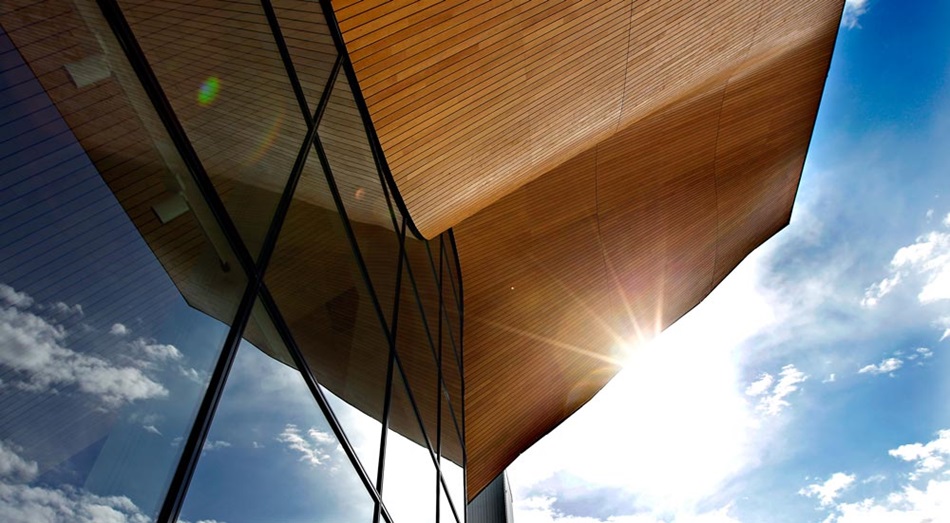
It took 370 years to build Kilden
Published January 7, 2015
Written by Emil Otto Syvertsen
In 2011, Kilden was Kilden on Silokaia in Kristiansand, 370 years after the city was founded. Anyone who has visited Furulunden in Mandal has an idea of what the area where Kristiansand stands today looked like before 1641. That year, King Christian IV decided to establish a city at Sanden, a strategic location between the mouth of the Otra River and the then-well-known port of Fleckerøe. The king ensured that it would be a city with military fortifications and a growing population.
We know very little about cultural life in the early days. “In the first few years after the town was founded in 1641, there was, quite naturally, no musical life of any significance. The population was small; it was not easy to persuade people from the countryside to move into the new town, and those who did come were surely so busy with trade, crafts, and other practical tasks that something as unprofitable as cultivating music for the sake of enjoyment—no, that was out of the question,” according to an article by Lecturer Erling Heide Sørensen in Fædrelandsvennen in 1955.
“Nature Music”
In 1892—the year half the city burned down—Ferdinand Rojahn (1822–1900), the cathedral organist, published a “Historical Overview of Musical Conditions in Kristiansand.” He writes the following:_ “The music that resonated for Kristiansand’s first settlers was purely the music of nature. It was the evening breeze rustling through the tall pine trees, the lapping of the sea against the deserted shoreline, and perhaps the hoarse song of a crow as it flew curiously over the new rooftops.”
But in 1704, we have concrete evidence: King Frederick IV undertook a grand tour of Norway, and Admiral General Gyldenløve, who accompanied him, kept a detailed diary. This is what he wrote after the visit to Christianssand: “On May 7, while the king was dining, he was entertained by a concert consisting of violins, whose strings were bowled with relentless vigor, a positive organ, and a wretched aria sung by the town cantor, accompanied by voices that beer and brandy had driven to the very utmost extremes.”
The town becomes a "diocesan seat"
From the town’s earliest days, the church on the town square was one of its most important institutions, and culturally speaking, undoubtedly the most important. The first—a simple wooden church—was built just four years after the town’s founding, on the site where the cathedral stands today. We do not know if it had an organ, and it burned down about fifty years later. A stone church was then built, consecrated in 1696, and burned down in 1734. It certainly had an organ. And at some point during this period, the city’s first organist position was established. This was likely the city’s first professional musician. When the city’s third church was consecrated in 1738, the new organ arrived a few years later.
Christian IV had envisioned and planned a city with room for 15,000 to 20,000 people. Twenty-five years after its founding, there were 230 residential buildings in the city, home to 1,500 people. In 1666, the city became a garrison town, and in 1682, it became a diocesan seat, county seat, or regional capital; that is, we gained a bishop and a diocesan administrator (county governor), and the city had 1,700 inhabitants. With the bishop, the city’s church became a cathedral, or “cathedral” as it is called on the Continent.
The small town is growing
The population of the new diocesan seat fluctuated, depending on economic conditions abroad, wars, and periods of plague. At times, about half of the city’s population consisted of immigrants from Denmark, Germany, and the Netherlands in particular; the rest were farmers from the surrounding districts. In 1700, the city had 2,200 inhabitants. By 1800, the population had reached 4,800, and by 1815, it had already grown to approximately 7,000. It was not until around 1860 that the city surpassed 10,000 inhabitants, and the population then increased steadily to nearly 15,000 by 1900. By the end of World War II, the population was 23,172, an increase of 1,000 during the war. When the city merged with the surrounding municipalities of Randesund, Tveit, and Oddernes in 1965, the population exceeded 50,000. We are familiar with the rest of the development, and today the city has 80,000 residents. Considering the population, the artistic and cultural activity in the city is, at times, quite impressive.
Holberg in Kristiansand
The ideals of the Enlightenment in the 18th century naturally also had an impact on life in the small coastal town in Southern Norway. The Dramatic Society was founded in 1787. Around the same time, the Musical Society was established—and the two societies collaborated extensively. However, while the Dramatic Society has been active almost continuously for 224 years, the Musical Society has been dissolved more often than it has been revived.
One of the earliest accounts we have of theatrical activity in the city is linked to none other than Ludvig Holberg. He lived in the city during the winter of 1705–06—just over 300 years ago—from August to April. There is good reason to believe that in the spring of 1706, Ludvig Holberg contributed to the production of a “school comedy” in Kristiansand, a play with biblical content titled “Vincula Petri” – the imprisonment of Peter.
The Drama Society
The Dramatic Society of 1787 was an exclusive circle of the city’s upper crust. Class distinctions were enormous at the time, and the aristocrats who performed in plays took care to avoid being seen by “the common rabble” by performing only for one another. Members were obligated to play the roles assigned to them, which often led to pleas to be excused and resignations if they were not.
The first theater, or performance venue, consisted of a single room, a hall on the property of Thaulow, the town clerk, in Østre Strandgate. But when membership rose to 123, this became too cramped. Therefore, membership was limited to 110. Henrik Arnold Thaulow (1722–1799) was the father of Alette Dorothea Thaulow, who married Nicolai Wergeland—and consequently, he was the grandfather of Henrik, Camilla, and Oscar—all three of whom have bronze statues here in the city. And as for the family’s interest in theater, it is worth noting that the Thaulow house on Bragdøya is likely the only vacation home in Kristiansand that has its own theater stage in the stairwell between the first and second floors.
The Comedy House
In 1807, the Dramatic Society was able to inaugurate its first theater. Known as the Comediehuset, it was a single-story building constructed right next to the city’s clubhouse, roughly on the site where Kristiansand Theater—which until recently housed Agder Theater—is located today. The building stood until the city fire of 1892. Throughout all those years, it served as a venue for the Dramatic Society and for a number of visiting ensembles. You can read about what took place here in Ole Dommerud’s 1976 book, “Aspects of Kristiansand’s Theater History – The Dramatic Society 1787–1976.” The book is a primary source for this article.
Dommerud writes: “During the great fire of July 8, 1892, the property of the Dramatic Society, the Christiansand Theater, built in 1807, burned to the ground.” But by August 1895, the new theater building was already complete, financed partly by insurance proceeds and partly by the Dramatic Society. The venue had 500 seats. At the inauguration on August 18, actors from Christiania performed “Little Eyolf” by Henrik Ibsen. Vilhelm Krag wrote the prologue, and the Christiansand Amateur Orchestra played a festive march composed by organist Ingarth Rojahn. A telegram was sent to Henrik Ibsen—who replied that same evening with a telegram in which he expressed his thanks and best wishes for the new theater.
Cultural Center Operations
The theater buildings—both the old one and the new one from 1895—served as a home for both the Dramatic Society and what we today call a “cultural center”—that is, for visiting artists and troupes. And the “cultural center operations” were, at times, impressive. This is documented by Associate Professor Frank Høgberg, who is currently gathering material for a history of music in Kristiansand. He recounts that in August 1873, a group of German singers performed the following program at the theater: The Barber of Seville (Rossini), twice; Martha (Flotow), three times; Norma (Bellini), twice; and a work by Alessandro Stradella—that is, four operas in a single month. The same thing happened in both 1881 and 1888—that year, there were eight operas in ten days. Ole Bull gave a concert at the theater in 1860, and 500 people were in attendance. That was five percent of the city’s population. Today, we can fill Kilden 2.5 percent of the city’s 80,000 residents.
City orchestra and symphony orchestra
The 20th century is closer to us in time, and we have a great deal of knowledge about the subsequent development of the city’s music and theater scene. In 1919, the Kristiansand City Orchestra was founded. At that time, movie theaters were already operating in the city, and as long as silent films reigned supreme, professional musicians were hired to provide musical accompaniment for the films. A rich musical life flourished within the Ynglingeforeningen, at times featuring a 40-piece orchestra. Until the 1970s, the City Orchestra consisted of both amateurs and professionals; the latter came from the Divisional Band—which, in fact, was repeatedly threatened with closure throughout the entire century.
The city orchestra became the Kristiansand Symphony Orchestra in the 1980s, when professional string players were finally hired and a chamber orchestra was formed. With the musicians from the Division Band, the ensemble had, in practice, largely become a small symphony orchestra. In 2003, the two institutions merged, and today we are in the fortunate position of having a very good symphony orchestra with approximately 60 full-time musicians.
Opera City
In the 1930s, the city experienced a rich flourishing of opera and operetta performances, linked to Heide Sørensen’s opera choir and, later on, as a result of Bergljot Schoder Dahl and her husband Thilo moving to the city in 1936. The significance of the Schoder couples—both the first and the second generation—for Kristiansand as an opera city can hardly be overstated.
The lovely little theater on the corner of Kongensgate and Vestre Strandgate met a tragic fate in the 1960s. Mold had taken hold in the walls and floors, and one fine day the large chandelier fell onto the stage, fortunately while the auditorium was empty. As a result, the building was closed, condemned—and demolished. Many have since regretted this.
No thanks to regional theater
The new theater—which has since been vacated—was inaugurated in 1976, with the Dramatic Society still serving as a key driving force. The opening performance was Baldevins brullyp by Vilhelm Krag, which Fædrelandsvennen’s Gunvald Opstad marked by writing a scathing review, delivered as irony—clad in language that belonged a century earlier. In hindsight, one sees that this was perhaps not primarily intended as a critique of the production itself. Rather, it was a critique of the fact that the cultural authorities and cultural policymakers in Kristiansand, strongly backed by the leadership of the city’s largest newspaper, had in the meantime—that is, between 1964 and 1976—managed to turn down the state’s offer to provide the region with a regional theater. It would take nearly 20 years, all the way until 1995, before the city got a regional theater on par with the other regional theaters. Financially speaking, the theater had by then fallen behind quite significantly.
During its heyday in the 1980s, the Friends of the Opera had over a thousand members. This made co-productions with the National Opera possible. And when the “opera report” was released—following the decision to build a new national opera house in Oslo and abandon the idea of a regional opera—Kristiansand was very quick to establish a collaboration between the theater and the orchestra—in Opera Sør, which also secured a letter of intent with the Norwegian Opera stating that Kristiansand would have a production unit. This collaboration has been a key factor in the development leading up to Kilden.
They did it
A number of other key players have played a vital role in developing Kristiansand as a cultural city and thus laying the groundwork for the construction Kilden. One can mention the Church Festival, which has been and continues to be vital in attracting international artists to the city and in cultivating an audience. The Cathedral Choir with its fine traditions, Schola Cantorum a few years ago, Musikkens Venner with over 60 years of history, the rich choral scene in the Free Church, Fru Skjeie and her children’s theater, the organization and individuals behind Like til Betlehem, Toffen and the Quart Festival, and of course the music conservatory with both its classical and rhythmic departments, now part of the University of Agder—all of this, and much more, are the building blocks that underpin and support what we now see rising.
And now here it stands, Kilden, Norway’s second-largest cultural building in modern times, and an experiment in the sense that three creative organizations from three different artistic disciplines have moved in together and begun their creative collaboration. The building is the result of forward-thinking politicians daring to make a decision whose full scope they likely did not fully grasp. But they did it. It will likely make Kristiansand a unique cultural city in Norway. It has taken its time, but from an eternal perspective, 370 years is, after all, a mere trifle.