Historical Background to Ibsen’s “The Lady from the Sea”
Henrik Ibsen’s *The Lady from the Sea* is a play full of contradictions. Even when viewed within the context of the author’s entire body of work, one can see both similarities and differences with his other well-known plays. Ellida Wangel is yet another female protagonist who leads an unsatisfying middle-class existence. She has certain marital problems and a past that sets her apart from the other members of her family and close circle of friends. In many ways, she mirrors the life and certain struggles found in Nora Helmer from “A Doll’s House” or Hedda Gabler from the play of the same name. At the same time, the problems are turned on their head.
A Happy Ending?
Henrik Ibsen is primarily known for his tragic works, with *A Doll’s House* and *Hedda Gabler* being two of the most iconic. In these plays, things end “tragically.” The “wonderful” thing Nora longs for never happens—and Hedda never gets to experience Eilert coming to win her back with vine leaves in his hair. The main characters long for something they will never experience. “The Lady from the Sea” is, in a way, different. For those unfamiliar with the story, no further spoilers are needed. But this much can be said—that even though we are not spared tragic endings for the characters in this play, it is still a story with more hope than in other works by Ibsen. At the very least, it is somewhat more ambiguous and bittersweet. While Torvald Helmer and Hedda Gabler are Ibsenian examples of people who are unable to change, we see a recurring theme in “The Lady from the Sea” regarding people’s ability and desire to change or develop themselves and their situation. We are not necessarily unchangeable and stuck. There is hope. For love, new adventures, and freedom.
Darwin, Mysticism, and the Sea
“Development” was a key concept and source of inspiration for Ibsen when he wrote *The Lady from the Sea*. He spent the summer of 1887 by the sea in Sæby, North Jutland, after several years living in Central Europe. His longing for the sea was something he himself expressed in repeated letters, and it seems no coincidence that the play he completed that summer at his home in Munich in 1888 is set in a seaside resort. Gone were the bourgeois drawing rooms. The action here takes place outdoors. By this time, Ibsen was a highly acclaimed and popular author in Europe and had already achieved several breakthroughs with his socially realist works that challenged societal conventions. Toward the end of the 1880s, however, he showed greater interest in exploring human aspects of biology and psychology. During the period surrounding the creation of *The Lady from the Sea*, he had shown great interest in Darwin’s evolutionary ideas. *The Origin of Species* is constantly referenced and alluded to in both this story and in *The Wild Duck* from a few years earlier. Ibsen wanted to play with the idea that we humans may not have acclimatized to land, since, according to Darwin, we originally came from the sea. Was it really the case that we were not created in God’s image, as Ibsen had always been taught? In “The Lady from the Sea,” this dilemma is embodied in Ellida Wangel’s longing for the sea and the past. She is a mermaid on land. Named after a ship rather than a “real human name.” The idea of sea people, mermaids, and other mythological creatures has consistently been a popular theme in our culture—and we can see inspiration for the work from various sources, including well-known tales such as Hans Christian Andersen’s “The Little Mermaid.”
Hypnosis and supernatural powers
Regardless of when his inspiration struck, there is little doubt that Ibsen took a keen interest in spiritualism and the supernatural. He was also deeply fascinated by stories about hypnosis—both its mystique and its use as a medical tool toward the end of the 19th century.
In earlier years, Ibsen had reportedly become acquainted with Magdalene Thoresen—who would later become the stepmother of his wife, Suzannah. While working together at the theater in Bergen, she told him about her past relationship with an unknown sailor from her time in Copenhagen. Time and again, she told Ibsen how this man had held an almost supernatural power over her, one she still could not shake. Was this also a form of hypnosis? Or was there something else in human nature that defies description? A primal force we cannot comprehend, and which we so easily dismiss as so-called “madness”? The pull toward the sea, the past, and this unknown man are clear sources of inspiration found in what would become “The Lady from the Sea” a few years later.
Abridged version
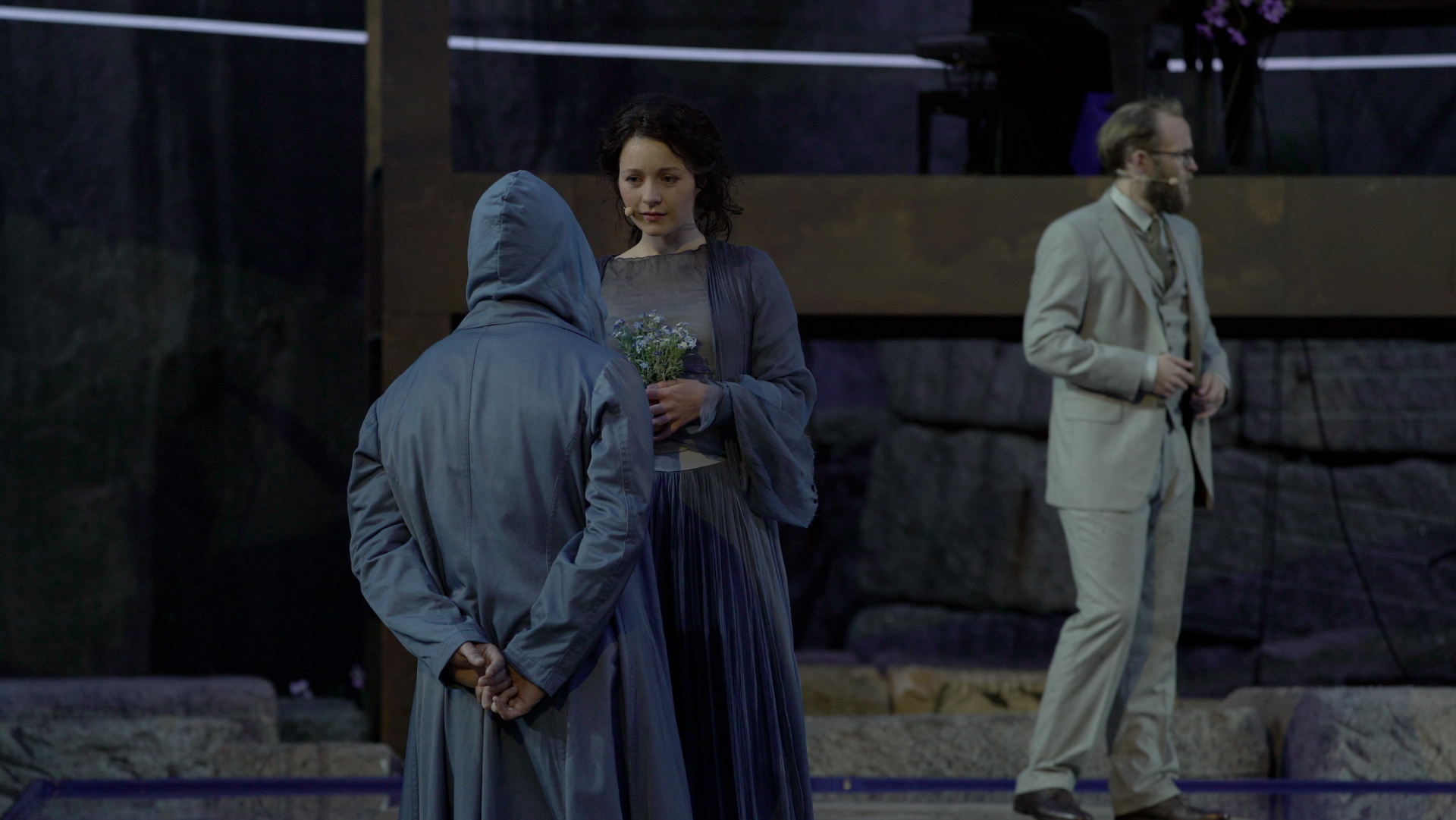
In 2019, *Ibsen’s Text* will be staged at Fjæreheia under the direction of Kilden in collaboration with the Chinese Yabin Studio. Ibsen’s original work is a long, text-heavy, and expansive five-act drama. In this version, the audience will experience an adapted and more condensed adaptation. The story remains the same, but certain artistic choices will give the audience an experience that allows more room to explore the rich symbolism and mysticism of the story in new ways. We also hope that the fantastic textual foundation will be enhanced by both visual and auditory elements, making the encounter with Ibsen’s work in the monumental setting of Fjæreheia the best possible theatrical experience.
By Endre Sannes Hadland, Dramaturg