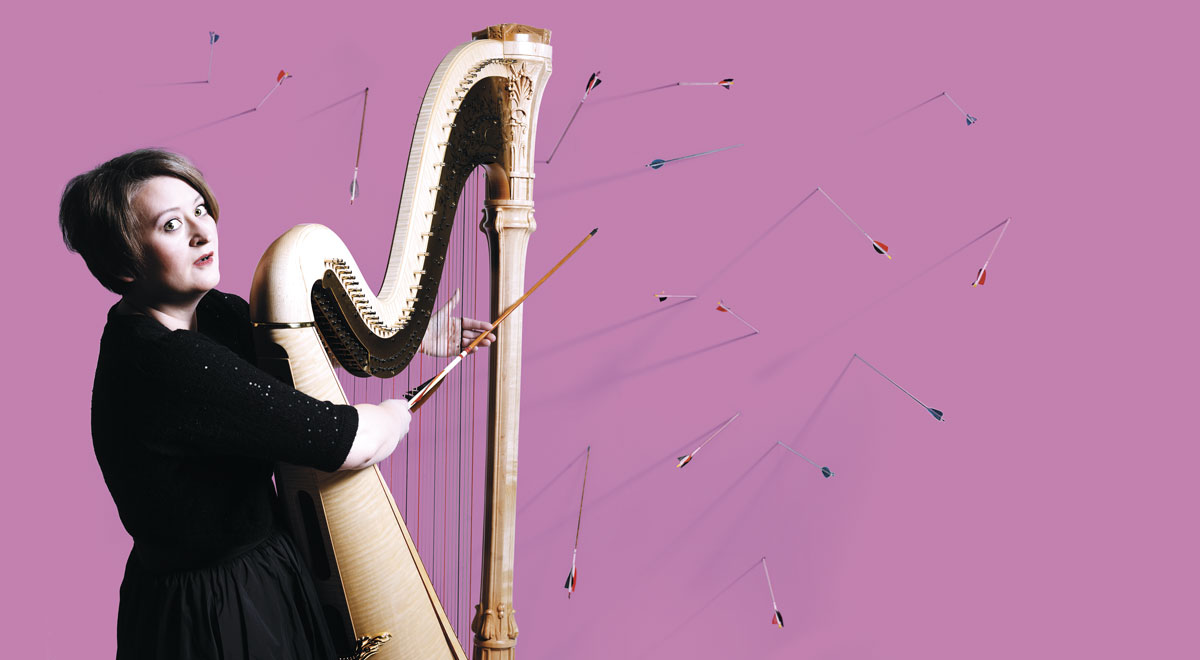
Not just angelic music
[ultimate_spacer height=»60″ height_on_tabs=»40″ height_on_mob=»40″]Johanna Nouisiainen spiller på flere strenger. Nå vil hun vise alle at harpe har et langt bredere og mer spennende register enn det vi er vant til.
Latin American rhythms from a symphony orchestra this fall. Harpist Johanna Nouisiainen has long wished for a rhythmically challenging concert by Argentinian composer Alberto Ginastera. In this concert, the harp is the solo instrument, and the musical style is as far from Disney and Debussy as you can imagine.
- "I hope it will be an eye-opener. People think of angelic music when they see a harp, but we are ordinary people with both angels and demons," says Johanna, who has played harp instruments for as long as she can remember.
Ever since she saw someone playing the kantele on the Finnish children's TV program pikku kakkonen, or "two little ones", she has been fascinated by the instrument. Her parents quickly realized that there was only one thing to do, and that was to find a kantele teacher for their daughter.
Started early
The kantele, the instrument that Johanna started playing, is a Finnish stringed instrument similar to the sitar or langeleik. From the age of six or seven, Johanna was taught to play the instrument, which has a strong place in Finnish folk music and is featured in the national epic, the Kalevala. Coincidentally, her teacher was also a harpist in the Tampere orchestra, and at the age of eleven Johanna switched to learning the concert harp.
- "It's heavy to move, weighing just under 40 kilograms, so it's not something you take with you to the beach," says Johanna.
- "The harp is actually one of the world's oldest instruments, dating back as far as ancient Egypt," says Johanna.
The total span of the 47 strings is over one ton, and it takes years to become a professional harpist. Johanna has studied with the best, including Dutch-Norwegian Willy Postma, and when she applied to Kristiansand, she was competing against more than 70 applicants for one harpist position.
- "The best harpists are those who can maintain a strong, dynamic core throughout their playing," she says.
According to her teachers, this is precisely Johanna's forte.
- "I never thought I'd end up in Norway," she says with a laugh, recalling her first encounter with the country, a road trip with her family when she was 15.
- "My father and his friend were keen to see Rjukan and the heavy water museum, so we drove the length of the country and stayed in cabins that summer. But it was a really nice trip.
Become a woman's beer
Johanna has been employed here for as long as Kilden has existed, and after a handful of years, her stay in southern Norway is about to become permanent for the Finnish virtuoso. She has found love in Kvinesdal and moved there.
- "I have a harp in Kvinesdal that I can practice on; it's a bit heavier to play than the concert harps in Kilden, but it's nice to have one at home. We symphonists are social people, but at the same time we find ourselves alone in tiny rehearsal spaces for many hours of the working day. If there's a week when I'm not playing a concert or practicing with the orchestra, I might as well spend the rehearsal days in Kvinesdal. Unless she's at work somewhere in the Nordic region.
- "Most Nordic harpists know each other well," she says, "and there is a bit of travel between the orchestras, especially if pieces are performed with a second harp. Some pieces are also written for four harps.
- At the end of the 19th century and into French Impressionism, we increasingly find that composers include the harp; it's popular in ballet music and some opera.
Solo harp
As I said, it's not just the angelic aspect of harp playing that appeals to Johanna. She intends to show this very clearly during Ginastera's harp concert.
- "I'm the soloist here, the whole concert is built around the harp, and unlike the type of music we've been talking about, this piece is more hard-hitting, almost percussion-like, and alternates between 6/8 and 3/4 time. It's strong, and it's fantastic. Everyone should go straight home and look up the concert on Spotify," she says with conviction in her voice. She herself will spend part of the spring and summer practicing for the performance.
Playing the harp is hard on the shoulders and arms, so Johanna has compensated with yoga. In addition to their hands, harpists also actively use their feet. Seven pedals regulate the strings up or down a semitone.
- "I used to play the piano, but when I sit down now, there's no power left in my little fingers," she says, giving them a little tug. You don't use them when you play the harp, and Johanna shakes her head slightly.
- The two little ones? Pikku kakkonen? we try.
Johanna laughs. She has to catch the train to Storekvina station. The women's moors and a rehearsal weekend await her.
Johanna Nouisiainen (b. 1982)
Harpist
Lives in Kvinesdal, Norway.
Educated at the Sibelius Academy, Helsinki and the Norwegian Academy of Music.
From Tampere, Finland
FACTS
Harp concerto, opus 25
by Alberto Ginastera
Commissioned by harpist Edna Philips and Samuel Rosenbaum in 1956 for the Inter-American Music Festival in Washington D.C. in 1958, whose purpose was to promote Latin American composers.