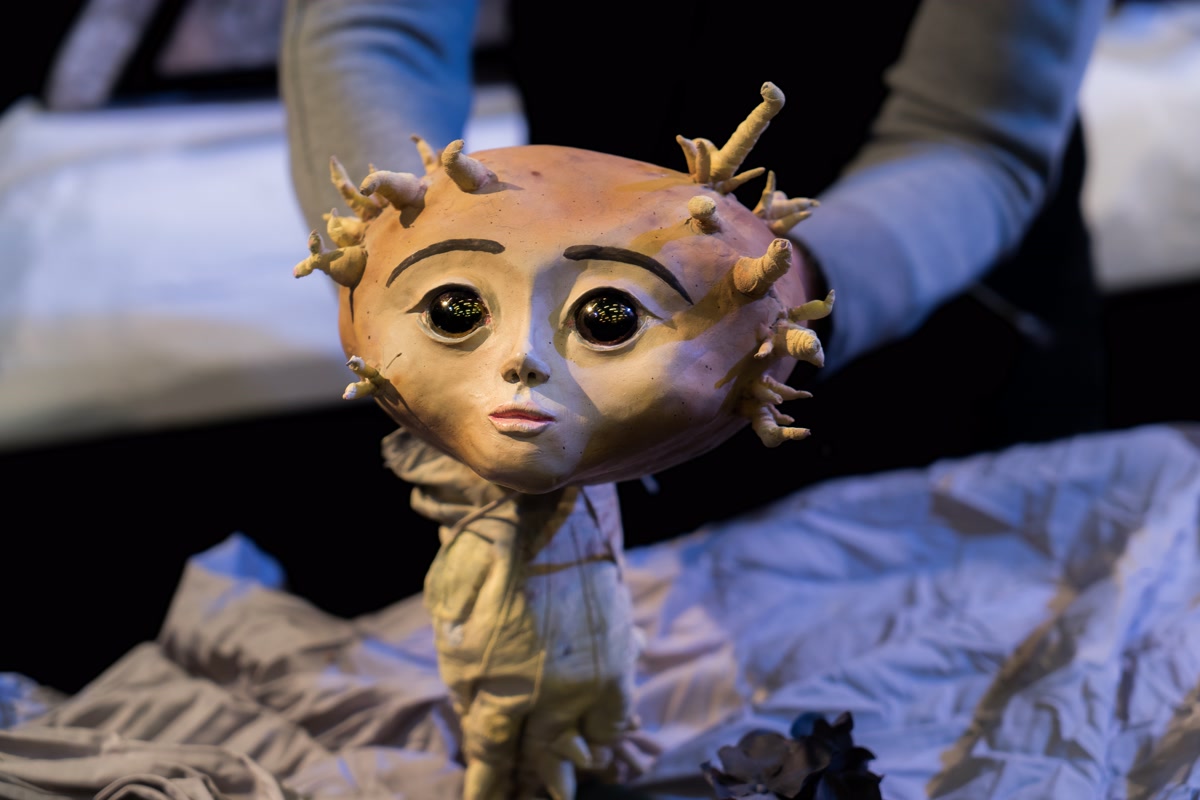
Teaching materials for “Potatoes Don’t Have Wings”
Assignments, activities, and discussion guides for schoolchildren who will be watching “Potatoes Don’t Have Wings.”
Exercises, activities, and conversation tips
Suitable for all grade levels in elementary school
Hands-on activity:
You will need: Drawing supplies for the youngest children, and writing materials for the older ones.
Here’s how: The youngest children can draw a picture based on the performance; the middle-aged children can create a word cloud or a mind map. The oldest children might write a letter to one of the characters in the play, putting their own thoughts and feelings into words and showing care for the recipient of the letter. Discussion: What did you experience when you watched the performance?
Suggested questions for discussing the play (from the concrete to the abstract)
Anyone who wishes to do so may share their experiences, or you may use some of the attached questions:
- What happened in the play? (Have the students retell the plot.)
- Who did we meet?
- What happened at the end? What do you think happened after the play ended?
- Were there times when you laughed? What made you laugh?
- Were there times when you were surprised? When?
- Were there times when you felt sad? What was sad about the play?
- Was there anything in the play that you liked, something that made you feel good?
- Everything we see on stage helps tell a story. So what did you see and hear? Were there any props (the objects on stage), sound, lighting, costumes, puppets, or anything else that you noticed that you felt conveyed a message?
Tips for icebreakers before a conversation about grief or death:
The goal of the game is for students to realize that they are not alone in feeling scared sometimes.
Here’s how to play: All students walk quietly around between each instruction. You give instructions that they must follow. (The instructions should ideally start with something simple and concrete, and gradually become more challenging.) The game is somewhat similar to “Simon Says,” but here it is always the adult who “gives the orders.” Example: If you say, “Everyone wearing blue socks must cover their ears,” then everyone wearing blue socks must cover their ears. Then the students walk around while some cover their ears; before they stop covering their ears, you give a new instruction. At the end, you may want to address themes of grief, fear, or death, and here are some suggested instructions. As the teacher, you know the students and what works best for the group. These are just suggestions:
- Anyone who has seen a dead bird flaps their arms.
- Anyone who has seen a hearse (with an explanation of what it is), hop on your right leg.
- Anyone who has turned the light back on after the adults turned it off in the evening and walked out the door, hop on your left leg.
- Anyone who has ever been afraid of monsters under the bed, jump like a rabbit.
- Anyone who has ever been scared while out at night, whistle.
- Anyone who’s ever had a pet that died, say “awwwww.”
- Everyone who has been to a cemetery, spin around in a circle.
- If you think dying sounds scary, touch your nose with your finger.
- If you're wondering about anything related to death that you've never talked to anyone about, sit down.
And this is where you can actually wrap up the game and move on to a conversation about feeling scared or sad, or thoughts about death.
Tips for theater games that can be used to further discuss both theater and the topic of grief:
The goal of this game is to introduce students to talking about emotions or to expressing emotions through theater.
Here’s how to play: All students walk around the classroom. When you say an emotion, they should act out that emotion with their whole body and face. The students can move around a bit as that emotion before you say “freeze.” Then everyone freezes in the emotion they are acting out. If it works for your group, two or three students can act out each emotion while the others stand frozen.
Emotion suggestions: Angry, relaxed, happy, jealous, moved, in love, offended, proud, scared, sleepy, sad.
Suggestions for further discussion about the play: What emotions were portrayed in the play? How did the actors get the puppets to express emotions? Discuss specific scenes and what was done to convey emotions.
Tips for further discussion about grief and death: Are emotions something we can see? How can we tell if someone is sad, scared, or happy? Maybe it’s not always easy to tell if people are scared or sad. Many people think that everyone else is fine while they themselves are the only ones who are scared or sad, because everyone else looks happy. But maybe that’s not really the case? Maybe everyone feels scared sometimes?
I told my teacher: Just because you feel it doesn’t mean it’s real: if I’m afraid my grandpa is going to die, my fear can’t affect whether he actually dies or not. Feelings don’t just go away: Even if I don’t talk about what I’m really afraid of, the fear doesn’t go away. Sometimes that fear turns into a stomachache, anger toward others, or feeling sad. Talking isn’t dangerous—talking is good!
Tips for further work on emotions: "Hjelpehånda" (by Solfrid Raknes) is a great educational tool for teaching children psychological first aid. Here is a link to a page where you can find more information about "Hjelpehånda."
Tips for theater games:
Introduction to the game: In a theater, everything on stage has to happen in quick succession. Everyone on stage must be completely ready for their part. There’s no point in sitting there thinking about something else while you’re acting. Now we’re going to play a game that’s often used in theater schools. It’s about concentration, acting with others, and always being ready!
Here’s how to play: Everyone stands in a circle. Player 1 points with both hands at another player in the circle and says “HI.” The player who is pointed at (Player 2) must then raise both hands above their head and say “HA.” At the same time, the two people standing next to No. 2 should clasp their hands together and point at No. 2 while saying “HO.” No. 2 should then clasp both hands together and point at a new person while saying “HI.” This person responds with a “HA” while the two standing next to him say “HO”—and the game continues like this. Eventually, everything should happen very quickly.
Activity highlighting the importance of talking to one another:
Introduction to the activity: Sometimes the pain, the things we’re sad about, or the things we’re afraid of can feel like a big knot in our stomachs. Imagine if this ball of yarn were my painful knot in my stomach. Maybe it got bigger sometimes—when I thought no one understood me, when I felt alone? Not all the pain can go away, but often things can get better when we talk about them. It doesn’t have to be just when someone has died; there are many things we can be afraid of or sad about. Everyone stands in a circle. What if I dared to tell “Ole” that I’m afraid of dying? (Throws the ball of yarn to Ole). Maybe Ole dared to tell me that he was a little afraid to go down to the basement alone. Then we’d share a bit of that knot in our stomachs. Then maybe I’d dare to tell Mari that I’m sad because Grandma is sick and I’m afraid she’ll die. Maybe Mari would say something nice to me when I told her about Grandma. Then maybe I’d throw it to someone else. Now I can pass the ball of yarn to you one by one. Before you pass the ball of yarn on, you can say one thing inside your heart that you think it would be good to say to someone else.
Something we’re afraid of or sad about. It’s not something we want to say to the whole class, but maybe you can say it out loud to an adult or a good friend later today? Everyone must be quiet and think about what they want to say inside their hearts. We’ll give each other some time before passing it on. Then I might pass it to someone else. Now I can pass the ball of yarn to you one by one. Before you pass the ball of yarn on, you can say one thing to yourself that you think would be good to say to someone else.Two tasks for each grade level:[dfd_accordion style="style-1" active_section="-1" font_size="18" tab_text_color="#000000" icon_size="14"]Tasks designed to help students talk coherently about their experiences, and put their own feelings and opinions into words (from the Norwegian curriculum).
Drawing and Discussion: We recommend that children in the lower grades start by drawing a picture related to the play or to grief. Discuss what they have drawn. This allows the children to share their experiences and helps them put their feelings and thoughts into words.
Puppet show:
You will need: Sticks or straws, tape, paper, scissors, and colored pencils. One cardboard box per group. Optionally, a flashlight to create light.
Here’s how to do it: Divide the class into different groups. Each group will create its own little puppet show. The simplest option is for all groups to create a short play based on the same theme and using the same paper puppets. Different groups can also act out different scenes using different puppets: Suggestions for different plays:
- At Mom, Dad, and Lela’s house before Lela died. We’ll see what life was like for the family back then.
- What happened when the potato ran away from the mashed potato factory?
- What happened after the play was over?
- Or create a puppet show based on the attached script excerpt.
The groups must create puppets based on the play they will perform. There aren’t many characters in the plays, but they can also make a variety of props that are attached to sticks or straws and used in the performance. For example, a soccer ball, a puppet, a mashed potato monster, etc. Perhaps someone in the group could also be in charge of lighting and sound? Or decorate the cardboard box with the right background? The figures are made by drawing them on paper (preferably thick paper), then gluing them to a stick or straw. The cardboard box must be cut out to form a theater stage.
For 3rd and 4th graders:
Activities that encourage students to express their thoughts on life, loss, and grief, as well as the good and the bad, and to respond to others’ thoughts (from the curriculum for Christian, Religious, and Ethical Education, Philosophy, and Ethics), as well as to express their own thoughts and experiences regarding children’s literature, theater, film, video games, and TV programs (from the curriculum for Norwegian and Oral Communication).
Discussion about the play: In the play, we meet a mother and father who are very sad. Their daughter died when she was six years old. Today, May 6, is her birthday. She would have turned 13. She has been dead for seven years.
Questions: What does it mean to be dead? Why do we feel sad when someone dies? Why are many people afraid of death? Have the students reflect during a teacher-led discussion. Or have them pair up, and then have each pair join another pair to share their thoughts. Finally, go around the room so each group can share something they’ve been thinking about.
Suggestions for what a teacher can say about death: I can say, “I’m just going to the store for a bit, but I’ll be back.” But to die is to pass away—and then never come back.
Many people all over the world and from different religions and worldviews believe in life after death, but no matter how they envision this, it is still a life different from the one we live now. When we are alive, we breathe, our hearts beat, we think and feel. When we die, everything in the body stops working. It is as if a machine stops working. The heart stops beating, we cannot feel or think, and the whole body grows cold. We do not know exactly what happens afterward. But we know this: When we die, the body cannot come back to life. Death is something we call final, something we cannot change.
Have you ever played soccer and then lost? Do you know that feeling in your body—that you’ve been cheering and cheering and hoping it would turn out okay? But then it doesn’t. And when the referee blows the whistle to end the game, it’s just over. In a way, death is a bit like that. Death is something we simply can’t do anything about, no matter how much we want to protest. And at the same time, death is so completely, completely different from a soccer game. Because even though we’re angry or sad when we lose an important game, it’s not something we find painful and difficult for a very, very long time.
Activity involving role-play and discussion:
Introduction to the assignment: Everyone deals with death and grief differently. It’s normal, and it’s OK whether we cry a lot, don’t cry at all, get angry, or don’t. Even adults don’t always know exactly what to do when they lose someone.
- What do mom and dad do to show that they care about their daughter?
- The mother wants to send Lela a doll. The father wants to light a candle. But what could they have done together?
Mention that the parents aren’t quite able to talk to each other about their grief. Sometimes that can happen. Everyone can feel so much pain that they no longer know what to say or what to do.
At the same time: Here we encounter parents who are grieving. But it is the adults’ job to comfort children, provide them with a sense of security, and be there for them.
The task: Pair up in twos. One person can be the mom and the other the dad. The mom wants to send a doll to her daughter. The dad wants to light a candle. Act out a scene where you, as mom and dad, try to explain what you want—but at the same time try to listen to each other. The children should act out a scene where the parents can’t agree. Then they act out a scene where the parents figure out how they can do something together. Feel free to demonstrate a sample skit first. Tasks that encourage students to express and justify their own viewpoints and show respect for others’ (…), take on different roles through drama activities, reading aloud, and presentations (from the Norwegian curriculum, oral communication).
Theater activities:
Here’s how to do it: The students form groups. Each group is assigned an excerpt from the play. The students should assign different roles within the group (see the list of theatrical terms in the introduction):
- Set design and scenery
- Cast
- Props
- Light/light
- Two people will serve as ushers: they will welcome guests and make sure everything runs smoothly.
- The group will act as both director and dramaturg and decide how they want to develop the plot of the play before they begin rehearsing.
It’s a good idea not to spend too much time on preparation; most of the props can be found in and around the classroom. It’s also fine if the actors perform with the script in hand.
Discussion: Students can watch each other’s plays. The audience can identify three things they found exciting, creative, or impressive about each performance. They are also encouraged to share a suggestion—“you could have done more with this.”
Reflection Exercise: Imagine it’s been a year since the potato visited. Write a letter to the potato from Fritjolf or Clara. Since then, the parents have managed to start talking to each other again. They’ve even felt a little happy from time to time. In the letter, the student should put themselves in the role of one of the parents and explain what it meant when the potato came to visit them and how they’ve been doing since then.[/dfd_accordion]Excerpt from the script:
Fritjolf: Comes rushing through the door, almost too out of breath to speak. He’s holding shiny chestnuts and a bird feather. “I found shiny chestnuts and a bird feather!” He’s taken aback when he spots Clara drawing on the wallpaper with a picnic basket on her head. He sees that Potato Girl is lying under the table with her eyes closed.
Clara: Finishes drawing and plays "Clara the Cowboy." "Now, my little horse, here I come to catch you." She jumps up on the table where Potato Girl is lying underneath.
Fritjolf: He chuckles quietly to himself, tucks the feather into his hair, follows Clara, and jumps up onto the table behind her.
Potato Girl: Makes horse noises. Prr prr...
Fritjolf: Makes low, guttural sounds.
Clara: Shh, shh, my little horse, I think I heard something. Turns around.
Fritjolf: Slips up behind her.
Potato Girl: Prr prr... Iha iha...
Clara: She puts her hands behind her back and feels that Fritjolf is standing behind her. Oh no...
Fritjolf: Makes high-pitched "Indian" sounds with his hand in front of his mouth.
Clara: Bang, bang, bang. The Indians are here! Fritjolf and Clara are play-fighting so hard that the table tips over.
Potato Girl: Rolls forward like a horse. Claps her hands. The super horse has been found!!!
Fritjolf: Looks at the wall. "Oh my, did you draw on the wall, Clara?"
Clara and Fritjolf: Giggle. Dance. Kiss.
Potato Girl: I get all flustered and embarrassed, just like a six-year-old. EW!
Clara and Fritjolf dance over to the Potato Girl. They sit down on either side of her.
Clara: She gives the potato girl a big hug. Now you're going to stay with us forever!
Potato Girl: Freezing.
Fritjolf: I'm hugging both of them. You, Clara, and me, right here in this house!
Clara: We're going to have soooo much FUN! I'm trying to put a bow on Potato Girl's bald potato head.
Potato Girl: NO!
Clara and Fritjolf: No???
Potato Girl: To Clara. You promised! You promised to get me back into the ground!
Fritjolf: He falls silent. He realizes that the potato girl has to go back to the soil. He doesn't dare say anything, because that would completely devastate Clara.