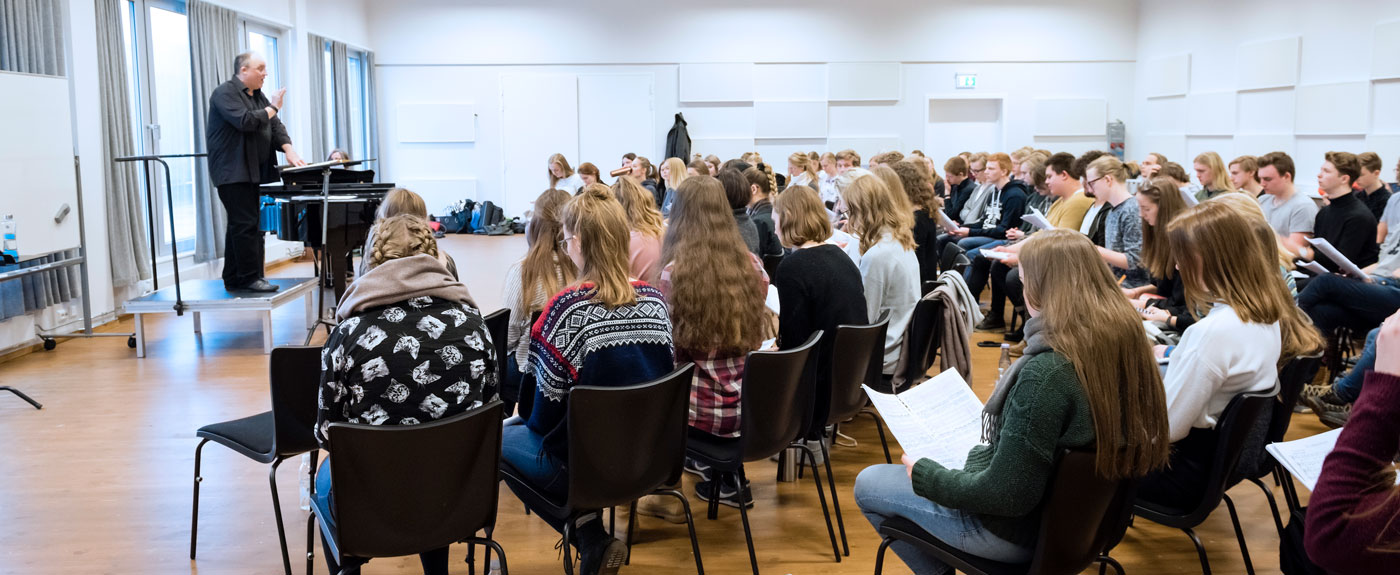
Here they sing about the struggles and hopes of young people
Choir conductor Ragnar Rasmussen struggles to keep a straight face as the hundred or so young people sing heartbreaking and honest lyrics to Mozart's Requiem.
[ultimate_spacer height=»40″ height_on_tabs=»30″ height_on_mob=»30″]
Brutal testimonies from young people with mental health challenges have been turned into texts set to Mozart's Requiem. Conductor Ragnar Rasmussen promises high artistic quality when music students from upper secondary schools perform the unique work, Mozart's death mass, which touches on a theme that is rarely put into words.
- Bravo! This was much better, but it's not good enough yet.
Choir conductor Ragnar Rasmussen steels himself. He barely manages to hold back the tears, but he can't control the sweat. It trickles
from his forehead as he conducts just over a hundred
youths singing heartbreaking and honest lyrics to Mozart's Requiem, which the world-famous composer never managed to complete before he died.
- "For me, this is deadly serious, and there will be a fine artistic level when we've finished rehearsing and are ready for the concert on May 5. But even at the first rehearsal, I have to admit that it's so wonderful and moving that I'm doing my best to "keep a straight face"," says Rasmussen.
In the back room, Stefan Sköld is listening. The director of Kristiansand Symphony Orchestra is smiling.
- Wow! It already sounds like a professional choir.
Anne Førde (18), Henning Stakkeland (17) and Håkon Huldt-Nystrøm (17) find it particularly powerful that Mozart wrote the piece for a funeral mass, and that the young people who wrote the lyrics experience such intense suffering.Bringing Mozart up to date
It has been a painstaking process that began with a joint writing room with ABUP at Sørlandet Hospital and Kilden over a year ago. Young people with mental illness have written down thoughts describing their own hell, and author Rune Belsvik has rephrased the testimonies into full-fledged texts adapted from Mozart's Requiem.
Singers from the music departments at the secondary schools have been rehearsing school by school since last fall. Now the young people have been assembled into a large choir, and the work will be performed together with the Kristiansand Symphony Orchestra.
KSO musician Pål Svendsberget was one of the initiators of the special project, which director Sköld is proud that Kilden is now staging. But he admits that he was skeptical about whether they could touch the sacred work
Mozart is, after all, the greatest composer of all time. At the same time, this is a way of making old classical music relevant to today's young people," explains Sköld.
Everyone has a friend they're with. Why am I all alone? Excerpt from the text "Lacrimosa".
So extreme it's disgusting
The young people who perform the work do not know who wrote the texts that author Rune Belsvik has adapted. But they do know that they are young people of their own age, perhaps from their own local community. It touches them.
- "Some of the lyrics are so extreme that it's disgusting to sing them. I really feel it in here," says 17-year-old Håkon Huldt-
Nystrøm and places his hand on his chest.
Both he and Henning Stakkeland (17) say that the fact that Mozart wrote the piece for a funeral mass, and that the young people who have written the texts experience such intense suffering, is particularly powerful.
- "It's almost unreal that the music and the lyrics were written so many years apart, because they fit together so well," says Henning.
I'm so tired of running away. Give me peace from what threatens. Extract from the text "Lacrimosa".
A look behind the facade
Anne Førde (18) thinks that many young people will recognise themselves in some of the content."Even though it's hard to understand that someone can have it as hard as the texts describe, all young people know that some periods are a little worse than others."You rarely get an insight into how other young people really feel, which is why this is important," she says.
Håkon says that he sees Mozart's music in a new light now, and that this experience has already had an impact on how he meets other people. "When I sing this, which was written by other young people, I take it in. It's taught me that you have to respect everyone before you make up your mind about them. It can be anyone who is struggling," says the 17-year-old.
Room for joy and sorrow
Conductor Rasmussen believes young people's openness is important and necessary: "Honestly, I'm glad I don't have to grow up now. The pressure on today's young people is more than many can handle, and now we're trying to give those who are struggling a voice. He believes it's right to do this through music.
- Nowadays, normal is not good enough, and it's terribly wrong. But music is a kind of counterbalance, because in music there is room for both joy and sorrow, and that's what we're trying to get in touch with here. That's why I imagine that this project is important. Very important," Rasmussen emphasizes.
Text Kari Byklum
Photo Børre Eskedahl