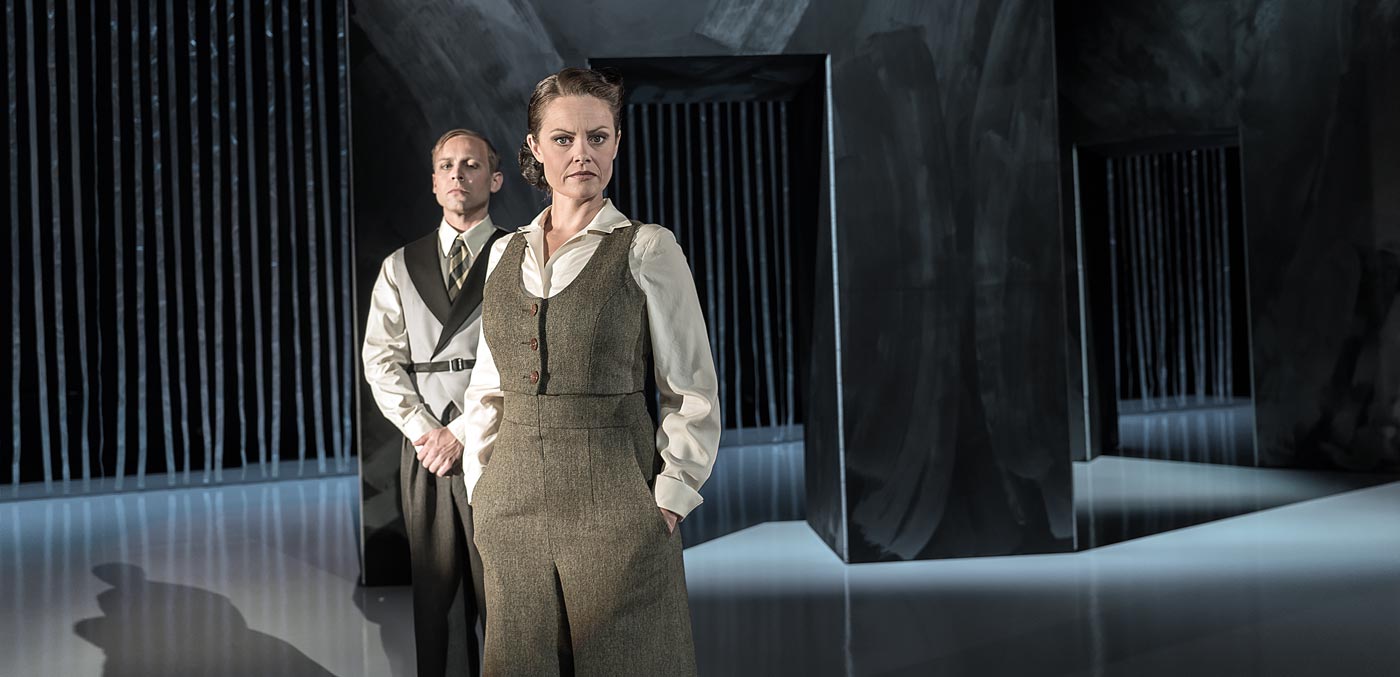
I want to clean the world
[dfd_spacer screen_wide_resolution="1280" screen_wide_spacer_size="60" screen_normal_resolution="1024" screen_tablet_resolution="800" screen_mobile_resolution="480" screen_normal_spacer_size="60" screen_tablet_spacer_size="40" screen_mobile_spacer_size="30"]
SNEKKEVÅG has written *I Will Wash the World Clean*, which is now having its world premiere at Kilden.
– It’s because I believe that, at heart, everyone has good intentions. Everyone wants to change the world they live in, or help make it a world they want to live in. That’s the same as being an idealist. Halldis’s story is a journey from idealism to fundamentalism. Norway’s history of World War II is marked by hero worship. We only tell stories about those who were on the right side, like “The Boys in the Woods” and “Max Manus.” I believe we need stories that force us to also look at the more problematic aspects of our history. That’s where we can learn, explains an enthusiastic Snekkevåg.
Are you defending her?
– I try not to judge her. That has been my goal: to write about her without judging her. I can’t defend her, because that’s too far removed from my own way of thinking and values, but I try to write about her without passing judgment. I hope I’ve succeeded.
“I TRY NOT TO JUDGE HER” Marius Leknes Snekkevåg, screenwriter.
Are you reluctant to pass moral judgment on her?
– I certainly wouldn’t put her in the “monster” category, as people often do. That trivializes her. It’s more frightening if one can say: I’m ashamed of my own passivity in the face of the reality I live in. That’s why she becomes a person to be feared, but at the same time admired. She takes action. She takes active action. She sacrifices herself for the cause she believes in,” explains Marius Leknes Snekkevåg, who has drawn much of the play’s text from the protagonist’s own writings and letters. The title alludes to her own stated motives for promoting the ideology of Nazism and the National Unity Party; to her own idealism and desire to “cleanse the world.”
Her hatred of Jews was intense. In hindsight, the consequences of her ideology were bloody and all too evident, weren't they?
“Yes, of course. It’s reprehensible, but there’s also something undeniably fascinating and deeply unsettling about a person like that,” explains Snekkevåg, pausing for a long moment as he searches for the right words to explain his position in this difficult ideological landscape:
– I wish I had enough passion and courage to go door to door to get people to contribute to the kind of society I want to see. I’m also fascinated by my own reaction to her story.
In his closing statement, the terrorist responsible for the July 22 massacres in Norway cited the Nazi ideologist Halldis Neegård Østbye as an inspiration. You are fascinated by Halldis as a person, but many people would rather focus on the consequences of this person’s actions. What are your thoughts on that?
– History is cyclical. We always wash our hands of the past. But that is where we can learn: precisely the fact that there is a blood-red thread running from her to Anders Behring Breivik, and to other types of lone wolves. You can almost trace it back to where it all began. That is why I believe her story should also be told. If we were to create a play about Behring Breivik, it would be so difficult that it would be almost unmanageable. It is easier to view the present through history, because that gives you some distance from it. That is also a reason why Halldis’s story can be told.
“IT IS EASIER TO SEE THE PRESENT THROUGH HISTORY, BECAUSE THAT GIVES YOU PERSPECTIVE ON IT”
Have you felt uncomfortable at any point while working on this story?
– Yes, absolutely. And I feel uneasy during reading tests. I’m not nervous, but I consistently feel uneasy because it all seems so familiar. It feels as though we’re talking about the present, about today.
Could her views have a contagious effect today?
– I’m not worried about any contagion effect. When we create this production, we’re very clear about where we stand in our ideological landscape. I think: When you walk out of the theater, whether you’re 16 or 60, you’ll think that since there might also be people like Halldis—who are on the wrong side of where I stand—then I have to do something: I have to join a party and start voicing my opinions. I can’t let voices like that go unanswered! That’s where we’re headed in our history. This is more of a rallying cry for you in the audience to take action yourself so that you can shape your society. That’s our starting point and our message in the performance,” explains Snekkevåg.
Where did you get the inspiration to write about Halldis Neegård Østbye?
“It was the article ‘Nazisten Halldis’ in *Dagbladet*, written by Jarle Samuelsberg in 2012, that first brought her story to my attention,” says Snekkevåg, who also cites the essay “Langs historiens blindspor” by Ivo de Figueiredo as an important source. The play’s title is inspired by a line from that essay: “She wanted to wash the world clean.”
– “In addition, I’ve drawn on information from Rikard André Toftesund’s master’s thesis, ‘When All the People Were to Believe the Lie: Halldis Neegård Østbye – Anti-Semitic Ideologist in the National Unity Party” from 2001,” says Marius Leknes Snekkevåg, who is working on a project involving three plays about World War II and Norway. He began with a play in 2011 about the Jew Moritz Rabinowitz, who lived in Haugesund but also owned clothing stores in Kristiansand, Egersund, and Stavanger. Rabinowitz was arrested in 1940 and died in captivity in Germany two years later.
– It was a play from the perspective of one of the victims. It’s about a powerful businessman who engaged in smuggling and openly defied the Nazis. Rabinowitz also appears in *I Will Wash the World Clean*, which, however, tells the story of Halldis, who deliberately chose the wrong side. Next spring, the third play, titled “Betrayers,” will be released. In it, I talk about the “front sisters”—those who were convicted of treason after the war but ended up on the wrong side unwittingly. They thought they were participating in something neutral, but were then convicted of betraying their own nation,” says Marius Leknes Snekkevåg.
Halldis died at Dikemark Psychiatric Hospital in 1983—without ever having expressed any remorse.
TEXT REIDAR MOSLAND
Halldis Neegård Østbye. The photo was taken around 1940 and comes from a press card indicating that she worked for the Nazi-affiliated publication *Fritt Folk* while traveling in Germany.[dfd_spacer screen_wide_resolution="1280" screen_wide_spacer_size="60" screen_normal_resolution="1024" screen_tablet_resolution="800" screen_mobile_resolution="480" screen_normal_spacer_size="60" screen_tablet_spacer_size="40" screen_mobile_spacer_size="30"][dfd_info_box icon="dfd-icon-note_check" style="style-02" layout="layout-06" title="The Theater Director's Comment" title_font_options=»tag:div» subtitle_font_options=»tag:div» font_options=»tag:div» subtitle=»Birgit Amalie Nilssen» border_radius=»0″]Over the eight years I have followed Marius Leknes Snekkevåg’s writing, he has constantly surprised and challenged me—and at times made me wiser. Marius’s open-minded view of the world and his ability to draw historical parallels
to our own time give him a voice worth listening to. That is why I want to give his texts a stage. I hope many theaters will do the same.
“I Want to Clean the World” is a journey into one of those echo chambers we’d rather avoid. I believe we need to take that journey from time to time. If we are to influence our contemporary world, we must start by understanding those with whom we disagree.
[/dfd_info_box][dfd_spacer screen_wide_resolution="1280" screen_wide_spacer_size="60" screen_normal_resolution="1024" screen_tablet_resolution="800" screen_mobile_resolution="480" screen_normal_spacer_size="60" screen_tablet_spacer_size="40" screen_mobile_spacer_size="30"]