The Path to Dignity for One's Child – A Timely Address
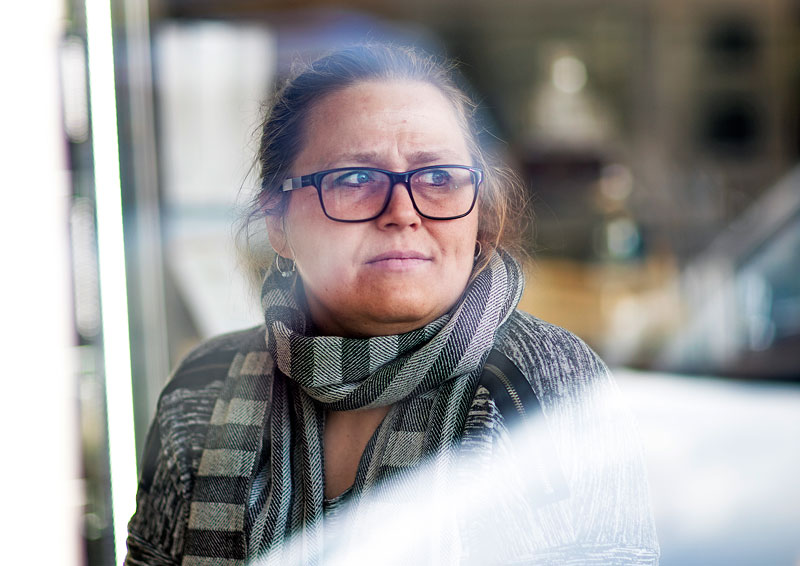
[dfd_spacer screen_wide_resolution="1280" screen_wide_spacer_size="20" screen_normal_resolution="1024" screen_tablet_resolution="800" screen_mobile_resolution="480" screen_normal_spacer_size="20" screen_tablet_spacer_size="20" screen_mobile_spacer_size="20"]Author Olaug Nilssen is the mother of a ten-year-old with autism. She has written a book about her struggle against the gatekeepers who have buried her everyday life in endless correspondence. Now her book, *Tung tids tale*, is being adapted for the stage.[dfd_spacer screen_wide_resolution="1280" screen_wide_spacer_size="20" screen_normal_resolution="1024" screen_tablet_resolution="800" screen_mobile_resolution="480" screen_normal_spacer_size="20" screen_tablet_spacer_size="20" screen_mobile_spacer_size="20"]The sun is rising over Paradis in Bergen. Brief coffee meetings and laughter characterize the atmosphere inside the cozy café. Colonialen is a sanctuary for thought, a place where Olaug Nilssen has chosen to meet us to talk about her latest novel.
Tung tids tale is the story of her lifelong struggle for her son Daniel, who has regressive autism, a disability that developed gradually during his childhood.
The book contains powerful descriptions of her interactions with everyone involved in making diagnoses, allocating resources, and determining fates.
“They don’t understand the scope of the challenges we face; they have no concept of the ripple effects.
They just sit there and count,” says Nilssen.
You grab my glasses and toss them to the ground, grip my shoulders tightly, and press your face against mine, trying to look past my eyes and inside—at least, that’s what I think you want to do—right into me, into my head. For a split second I’m afraid you’re going to knock me down, but you don’t; you just hold your face right up close while you growl (…) Here and now I can just feel it, with my whole being, the loneliness of beginning to think the thought, the thought that I can’t be alone with you.
(Tung tids tale, page 91)
The Struggle for a Child's Seat
We drive the short kilometer up to Tveiterås School, a public special education school for children with autism. The teachers accompany us to see Daniel. We say a friendly hello to the ten-year-old; Daniel himself has no words to say in reply. He notices that we’re there.
Two teachers and Olaug herself help him put on his jacket and shoes, and we spend a few patient minutes getting into the car. Daniel doesn’t want to sit in the car seat; he’s more interested in an empty bottle, and his mother calmly tells him he needs to move to the right side of the back seat.
We meet the gaze of a small child with an obviously keen sense of observation, but without the means to express his own thoughts. A little boy who is confined to his own world, a world that is extremely difficult for anyone other than his mother to enter. If she even does. Daniel is deeply engrossed in his own interaction with the empty bottle. His mother patiently continues to remind him that he needs to come over so she can secure him in the five-point harness. A car seat that took her five months to convince anyone they needed support for.
NAV refused to provide funding for the car seat and stated in a letter that Olaug and her husband had to prove that they had exhausted all other options.
“I’m driving around with a living child unsecured in the back seat,” Olaug says she shouted at the bureaucrat on the other end of the line. After five months, we finally got the car seat.
I got you in the car, started the engine, turned on the music, and drove off. You threw yourself toward me between the seats, and I swerved into the wrong lane; it went well, it always went well; I wasn’t hysterical anymore; I handled it, calmed myself down, even though you were screaming in my lap; I told myself: I can’t stop until I have a place to do it. So we drove on, one in intense concentration, the other in complete disarray, and then I finally got off the road.
(Tung tids tale, page 97)
Much of the time since Daniel began showing symptoms of autism has been spent struggling with people who won’t cooperate. Gatekeepers who won’t open the door. Every minute of every day has been about staying one step ahead of his impulses. Planning for safety, both for parents and children. But things have gotten better. Now they can have flowers in a vase on the table at home. And of course, it’s not just a struggle, but also beautiful moments. Daniel isn’t a diagnosis; he’s a human being. Olaug has stopped using words like “progression.” She has finally embraced life as it is now, and believes there is strength in that realization.
– We’re constantly told how resourceful we are as parents, how strong we are for having managed to weather all these challenges while speaking out publicly about them. It’s almost as if they’ve been punished for it. The ability to dig in and fight an uphill battle.
Olaug Nilssen, mother and authorTo the scene
We’re back at the Colonial. Daniel is spending a few hours at his grandmother’s house. But his phone is left on next to Olaug’s coffee cup. Just in case.
We’re talking about her book, which is now being adapted for the stage by the National Theater. She isn’t afraid to let go of her personal story—and entrust it to a director.
“This is bigger than our history. I see the importance of bringing this issue to the forefront through art,” she says.
In the book, she describes the period from when a healthy and intelligent little boy could point out dialectal differences, from the moments when a four-year-old began to learn English words, to the days and months when the regression set in. When autism took over a bright and alert boy, and gradually cast a darkening veil over Daniel’s ability to express himself.
– You come face to face with yourself at the door, a human being with animal instincts. How are you supposed to deal with all that violence? What do you do when your own child hits you? And those who are supposed to help just hit you, too. With words. You feel the urge to hit back. Of course you do.
Olaug writes about her encounters with all the agencies that are supposed to be there to help. About the despair of having to admit that the diagnosis will change everything. About the struggle to preserve the dignity of a child’s mind, to be heard and understood.
“More people need to understand what it’s like to deal with a situation like this, how serious and challenging it can be. We need to raise awareness of this issue so that policies in this area can be improved,” she says.
Many people probably think, “No, we’ll manage everything on our own.” But that’s not humanly possible. You’re under immense pressure, driven by desperation, and severely affected by sleep deprivation. Lethargy is no stranger to you.
“I felt it was necessary to challenge the image portrayed in the media of having a child with a disability. There are too many rose-colored stories, and society can lose sight of just how great the need for assistance actually is—
”
she says.
Are you a normal child inside, or is it inside that you’re not normal?
(Tung tids tale, page 49)
Powerlessness and Anger
Olaug Nilssen believes that politicians have insufficient knowledge of the daily lives of families with children who have disabilities, and that those responsible for allocating funds have too little authority—both in terms of their mandate and their resources.
– This leads to a significant sense of relativism when dealing with those of us who are supposed to receive help. A selection process develops, one that deals with piles of applications, not people. For me, a deep rage has emerged that is about self-preservation. About powerlessness and anger, but also about agency. I want to be a catalyst for change. And that is why I am eagerly looking forward to seeing the explosive impact this play can have.
Director Marit Moum Aune has been entrusted with the prestigious task of bringing Olaug Nilssen’s literature to the stage, under the auspices of the National Theater.
“I’ve worked with Olaug for many years and have followed her since she wrote *Stort og stygt* for the stage. *Tung tids tale* is an incredibly powerful work, a monument to the struggle of life. I’m incredibly proud to have the opportunity to work on this important play,” says Moum Aune.
Text and photo by Amund Hestsveen[dfd_spacer screen_wide_resolution="1280" screen_wide_spacer_size="30" screen_normal_resolution="1024" screen_tablet_resolution="800" screen_mobile_resolution="480" screen_normal_spacer_size="30" screen_tablet_spacer_size="30" screen_mobile_spacer_size="30"]
ABOUT THE LANGUAGE OF THE TIME
This isn't a heroic tale. It's a love story.
A young boy loses his ability to speak and undergoes a personality change. For his mother, a struggle begins—first to understand what is happening to her son, and then to find the help she needs to provide him with the care and support he requires.
The family suddenly finds itself in a very difficult situation, and they have to go through long and exhausting processes to get help. People say that mothers should never give up, but what is acceptance, and what is giving up?
"Tung tids tale " is a powerful story about raising a child who is different. It’s about the struggle to have that child seen for who he is—and to get the support he and his family need.
[dfd_spacer screen_wide_resolution="1280" screen_wide_spacer_size="30" screen_normal_resolution="1024" screen_tablet_resolution="800" screen_mobile_resolution="480" screen_normal_spacer_size="30" screen_tablet_spacer_size="30" screen_mobile_spacer_size="30"]
A Heavy-Hearted Speech World premiere August 29. Runs through September 3.
[ult_buttons btn_title="READ MORE AND BUY TICKETS FOR THE PERFORMANCE" btn_link="url:https%3A%2F%2Fkilden2020.wpengine.com%2Fforestilling%2Ftung-tids-tale%2F||target:%20_blank|» btn_title_color=»#ffffff» btn_bg_color=»#7a3434″ btn_bg_color_hover="#5e5e5e" btn_title_color_hover="#ffffff" btn_icon_pos="ubtn-sep-icon-at-left"]