The Magic of the Elderly
Some old violins are revered as icons in the art world and are valued at tens of millions of kroner. If such instruments are to be played acoustically in Kilden's concert hall, in the hands of musicians in the region, financial muscle must be combined with musical ability. That's why Sparebanken Sør has now set up a foundation to buy and lend valuable old string instruments.
Today's four-string violin has deep roots in history, but was mainly developed from the middle of the 16th century in northern Italy - as what we later called the "baroque violin". Over the next two hundred years, builders in Cremona and Brescia, in particular, developed the instrument to be able to sound in larger rooms with an increasingly refined sound. The golden age came in the 18th century with the Amati and Guarneri families - and in particular violin maker Antonio Stradivari (1644-1737). His Stradivarius instruments are the source of deep longings and wet dreams for investors and top musicians alike. The most expensive Stradivarius was sold in 2011 for NOK 100 million.
Knowledge and the art of building
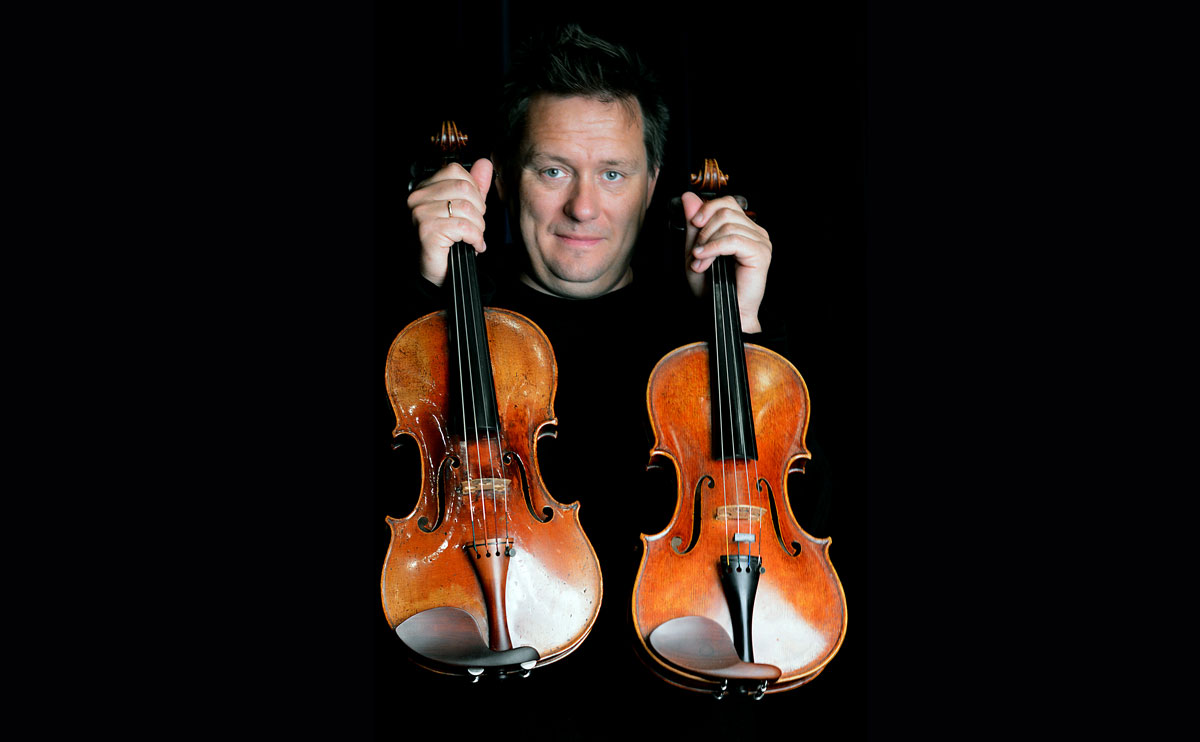
Adam Grüchot is one of our foremost violinists, concertmaster of the Kristiansand Symphony Orchestra and senior lecturer at the University of Agder. He respects and honors newly built violins and their talented creators, but his heart is still with the old, with the instruments created in the Golden Age in Italy and further through the 19th century in France:
- There's a lot that comes into play here. It's knowledge, it's art! Every violin, cello, double bass or viola is a work of art of which no two are alike. And the knowledge of the ancient fiddlers was probably at such a high level that they explored and discovered a lot that may have disappeared in the quest to produce masses of instruments. Also this with the wood: Several renowned violin makers in Europe and the rest of the world tell me that in the old days they knew exactly which day of the year to cut the wood for the instrument. It wasn't the case that the fiddler just happened to go into the forest one day in March and cut down a tree - no, by then it might already be too late, because the sap had started to enter the tree. Today, instrument makers can wait 80 to 100 years before using the wood, to get it dry enough. In the old days, they didn't do that. They knew what day they were going to cut and then the material was almost ready to be used. Another thing is that in the old days you didn't have the pollution you have now. All the little details come into play.
In the old days, they knew exactly which day of the year to cut the tree for the instrument.
Adam Grüchot, one of our foremost violinists, concertmaster of the Kristiansand Symphony Orchestra and associate professor at the University of Agder.
Wood is important
- Is this wood that no longer exists?
- It's true. Many believe that a lot of important wood has disappeared in Europe's wars, especially in the First World War. They used enormous amounts of wood in war production and therefore cut down a lot.
- So when the Balkans burned in the wars, so did the Bosnian maple trees that instrument historians have highlighted as important material for Stradivari and other greats?
- Yes, that included Bosnia and the Istra Peninsula. Another thing is that we humans have had an enormous need for very fine furniture. Cabinetmakers have also traditionally hunted for the most perfect wood. Among other things, this has affected the production of bows for stringed instruments. Fernambuko is a very hard and well-suited type of wood that has been used to make the best bows. Today, there is not the same access to such wood as there was in the 18th and 19th centuries. Everything has gone to rich people's beautiful furniture with the fine red-black stain that this wood gives. Today, this type of wood is so protected that I need a certificate to bring such a bow to the USA.
- What about the paint? Did they know something about that too, that we don't know today?
- They experimented a lot and didn't use the same chemicals as today. That probably had a lot to do with it, although it's not easy to hear now. Today, old instruments are often repaired. Most have been damaged or the varnish has been sanded down. Absolutely everything plays a role in an old instrument, but the material is particularly important. Along with the knowledge and the art that the fiddler created.
Special experience
- This spring, French researchers published a study - a blind test - which showed that neither professionals nor the public could hear much difference between old and new violins of the highest quality. It is also claimed that a skilled violin maker can recreate the sound of the old masters' instruments; the strength, the character. What do you say to that?
- Yes and no. An instrument builder I know believes that the old ones could tune the wood. In other words, different points in the lid - or especially the bottom - had just the right tone and pitch. And that has to do with the thickness of the wood. He talked about how few people know how to do this today, because so much is mass-produced. You can make incredibly fine copies, but the question is, among other things, how such an instrument will react to different weather and indoor climates. Instruments are very sensitive to the weather and react to moisture. An instrument is alive. If I go into konsertsalen , the wood expands or shrinks. If I go backstage, it changes. The wood is in motion all the time.
- But surely this applies to both old and new instruments? So are the old ones so distinctive that you can't get the same sound from a newly built instrument?
- The old ones have something, something special - something undefined. What I can say as a performer is that when you play a really good, old instrument, you feel comfortable. You allow yourself more and the instrument offers you more: "Relax, relax - you can do something else". As a performer, you feel it immediately when a note doesn't respond the way you want, then you get stressed. At the same time, Jascha Heifetz, perhaps the greatest violinist in history, has stated that it is the performer and not the instrument that creates the sound. That the sound is in your head. That's true, but when you get the opportunities that an exquisite instrument can provide, when you feel that "I can go further", it's an indescribable feeling for a performer.
The oldest are best
- So your answer to the French survey will be: These are your ears, these are your answers. But as a practitioner, do you know and experience something else?
- Yes, it's something you can't touch and can't measure. It's something indescribable. That feeling you get when an old instrument isn't the most beautiful thing in the world to look at, but has something you can't describe.
- Would you be afraid of having to participate in such a blind test yourself?
- I don't. If I were to try both, I'm sure I'd be very excited about a new one too. My wife Dorota (also a violinist in KSO) plays a wonderful English-built Del Gesu copy (copy of a Guarneri violin). I've shown it to the famous Israeli fiddler Amnon Weinstein in Tel Aviv, and he's said it's one of the best modern instruments he's seen in his life: Properly built, and not made to look old like some do.
- Do you play yourself?
- A French instrument made by Honoré Derazey from 1850. French instruments became very good when the great Italian school went bankrupt. Tarisio then bought the entire collection. Including Stradivari's famous "Messiah" violin," says concertmaster Grüchot.
He's referring to the year 1828, when Italian violin dealer and collector Luigi Tarisio (1796-1854) made a major coup and secured, among other things, an exquisite violin made by Stradivari in 1716. Because Tarisio talked about this violin all the time, but few had seen it with their own eyes, it was nicknamed "Messiah". After Tarisio's death, renowned French collector and violin maker Jean Baptiste Vuillaume first found the "Messiah" and six other masterpieces in a small farmhouse where Tarisio's descendants lived, and then 24 Stradivari violins and 120 other masterpieces in the Milan apartment where Tarisio died.
- Stradivari believed that "Messiah" was the perfect instrument, but that no one should play it. It should only be exhibited in his workshop. Vuillaume measured the old violins and made copies that today we have doubts about whether they are real or copies. They sound fantastic," Grüchot explains about the knowledge that now became part of French instrument making.
- But you still think the oldest are the best? And that you will notice a difference?
- I think that during my career I have developed my ears and my senses so that I can distinguish between an old and a newer instrument. And mostly when I play myself. It's hard to describe. I understand new tests and am excited about many new instruments and bows. But there are so many hundreds of years of good sound living in these old ones that you notice it," says Adam Grüchot - pausing to think, and giving the closest description he can of this indefinable, what raises the old instruments to their great heights:
- "Soul!"
Text and photo Reidar Mosland
Instrument fund
Sparebanken Sør has set up the Sparebanken Sør Instrument Fund Foundation to build up a collection of quality instruments from the great instrument makers of the 18th and 19th centuries. According to Stein A. Hannevik, chairman of Sparebanken Sør's instrument fund, the aim is to increase interest in classical music in Southern Norway and help encourage young people to pursue a musical career. Hannevik, the aim is to increase interest in classical music in southern Norway, and to help encourage young people to pursue a musical career.
- The best string players in southern Norway deserve the best instruments. Such instruments will lift any orchestra and will in future be lent to musicians in the Kristiansand Symphony Orchestra and to particularly talented musicians in the region," says Hannevik.