Fact and Fiction in the Arendal Scandal
When Kilden a play about the Arendal crash, a dramatic chapter in the history of Southern Norway is brought to light. But what actually happened, and why does this story still make an impression 140 years later? Historian Håkon Haugland at KUBEN in Arendal explains why it happened, but also attempts to answer the question: Could it happen again?
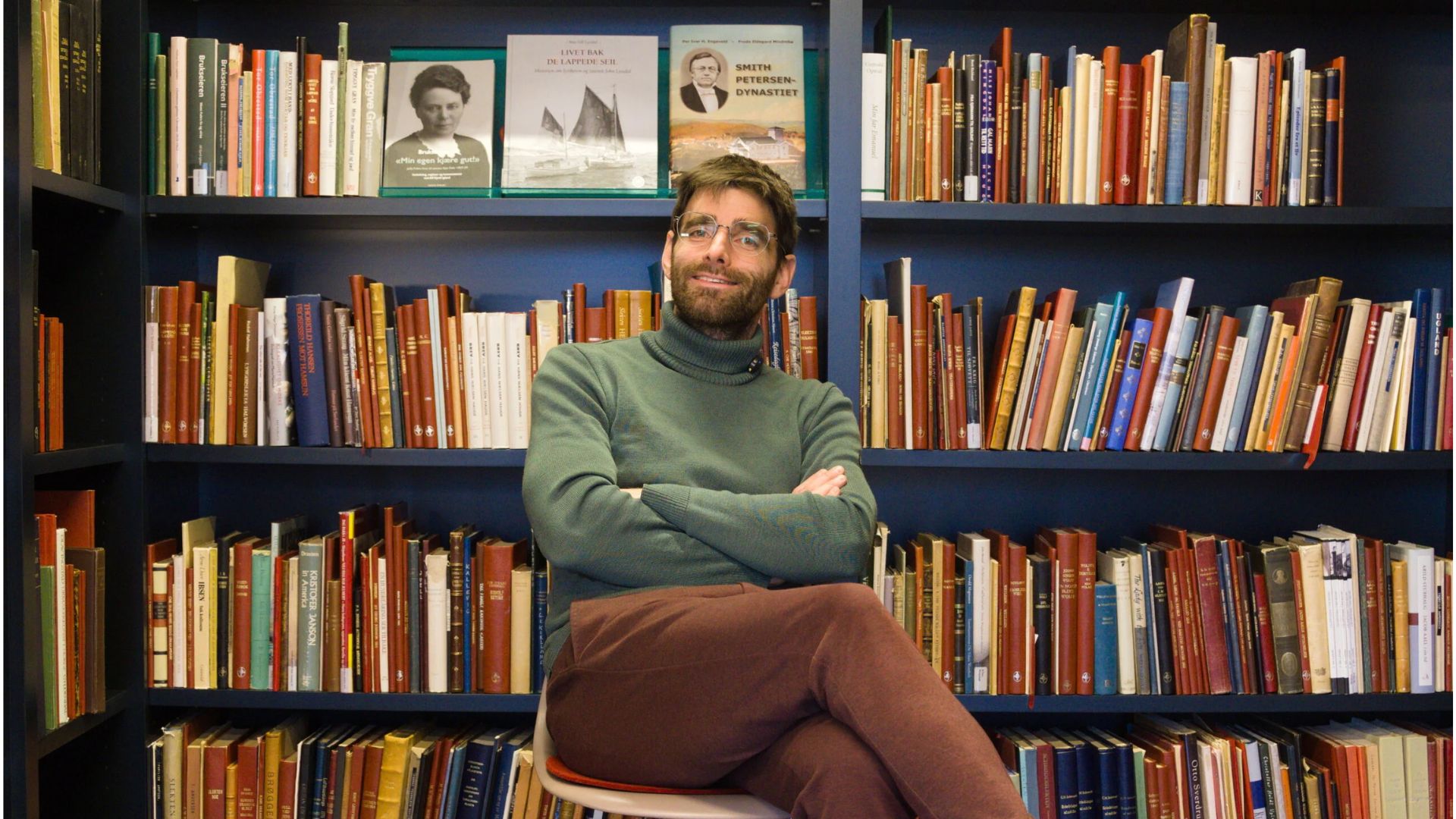
KUBEN, Arendal. In the reading room, the desks are surrounded by row upon row of tall shelves crammed with books that tell our shared history. Between two bookshelves, Håkon sits down in one of the chairs usually reserved for historians and genealogists.
He takes off his glasses, then puts them back on. “I actually have good eyesight, but I like my glasses as a sort of intellectual cloak,” Håkon laughs before he begins to talk about the Arendal crash.
– The Arendal Crash was a banking crisis, one of the first in Norway, and perhaps the largest in terms of total debt, prior to the Kristiania Crash of 1899.
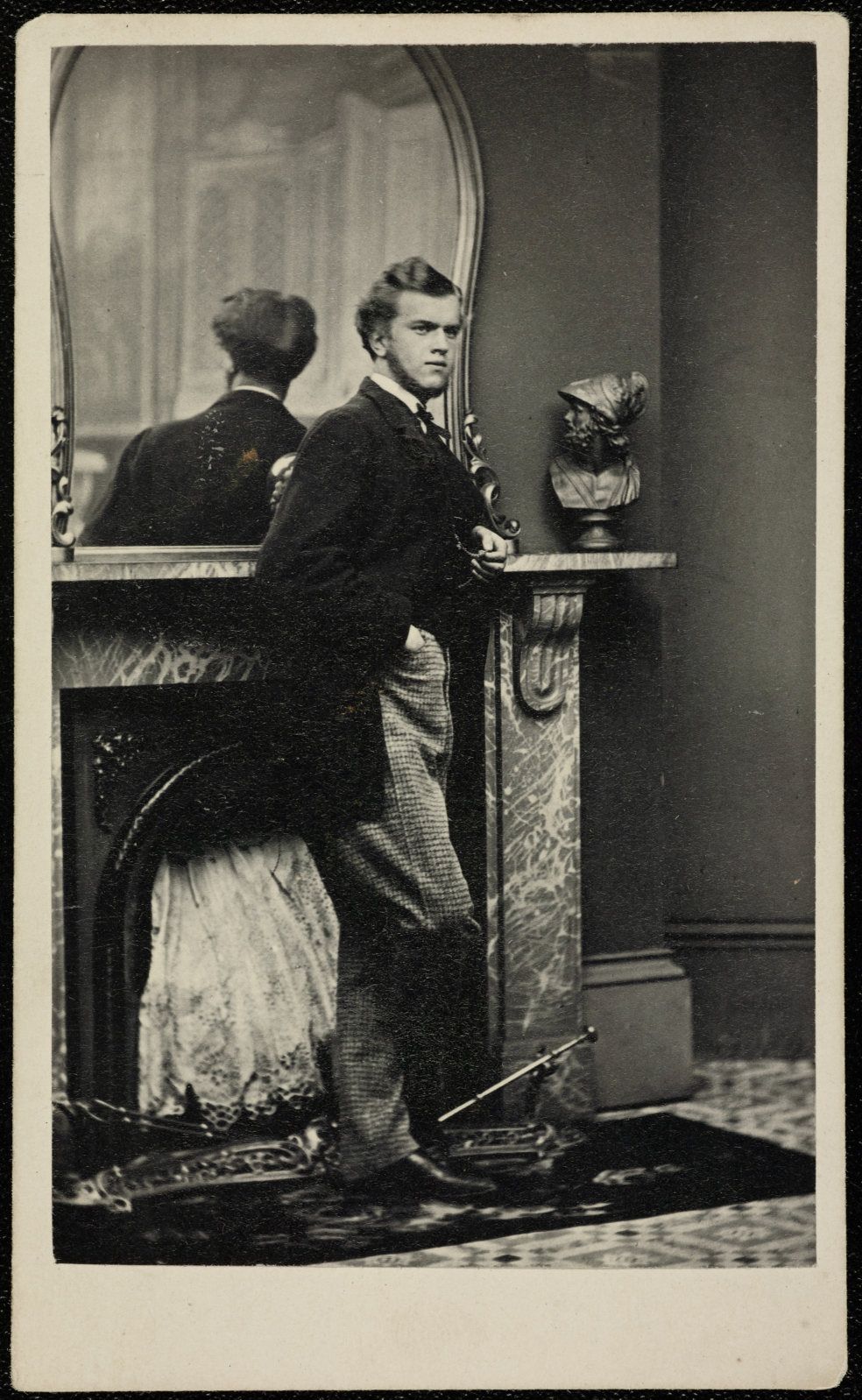
– In short, it was about three banks that went under within a few months in 1886 and 1887. But at its core lies the story of a spectacular bank fraud carried out by Axel N. Herlofson, a shipowner and bank manager, who manipulated figures, trust, and even his own closest associates to pay down a debt that had spiraled completely out of control, says Håkon.
When Håkon talks about the crash, you quickly realize that this isn’t just an economic collapse, but a drama worthy of the stage, and you might wonder why it hasn’t been made into a movie or a play until now.
To better understand how the bank fraud came about, we need to take a step back and look at what was happening in Arendal in the 1800s. Arendal, which wasn’t even among Norway’s ten largest cities, was Norway’s largest maritime city—measured by total tonnage—until 1885.
From sail to steam
The Arendal district was part of the heartland of Norwegian wooden shipbuilding. There was little industry; much of the local economy revolved around building and outfitting wooden sailing ships for long-distance voyages, and exporting lumber from the surrounding area.
Arendal grew rapidly and began acquiring ships at a rapid pace, transporting people and goods out into the wider world. For a long time, sailing ships dominated, but new technology that made more efficient use of the steam engine eventually rendered the sailing ships obsolete.
Those who failed to adapt were left with few, if any, opportunities.
Arendal was ill-prepared for the technological revolution that was on the horizon and lost ground in the competition against steam-powered ships. Unlike their sail-powered counterparts, steam technology made it easier to predict arrival times, among other things. Shipowners naturally preferred vessels that could ensure predictable deliveries and phased out the sailing ships.
When a cornerstone business disappears, nearby industries are also affected. When an entire industry virtually disappears in a short period of time, the decline is all the more severe.
This is where one of the major points of contention among historians arises: Was Axel Herlofson primarily responsible for the Arendal crash, or was he first and foremost a symptom of the times in which he lived—an era marked by excessive confidence in an industry on the decline and massive overinvestment during the boom years?
Håkon has no doubts. More on that later.

“Herlofson and his brother Oscar ran several businesses and shipping companies and employed between 300 and 400 people. When everything collapsed, many of them lost their jobs almost immediately. In total, around 1,100–1,200 people became unemployed during the fall and winter of 1886–87,” explains Håkon.
He asks us to imagine the consequences:
– Imagine a town where, in family after family, the primary breadwinner loses everything—not gradually, but suddenly. There was no social security office. No welfare state. People were left with nothing.
For many, daily life became unbearable. Soup kitchens, volunteer relief efforts, and food distributions saved lives, but it was a grim reality that set in almost overnight.
The municipality also had to step in. Arendal launched its own emergency work project—a trace of the collapse that is still visible in the cityscape.
– Songeveien, now known as Kystveien, was built during the winter of 1886–87 specifically to provide people with work. We still use it to this day.
In the wake of the collapse, something unexpected happened: a local labor movement emerged.
– The Samhold movement emerged as a direct result of mass unemployment. It laid the groundwork for the founding of the Labour Party in Arendal in 1887.
– That says a lot: The crash was devastating, but it also led to political awakening and organization, Håkon continues.
How much was the crash worth in dollars and cents?
The financial figures are almost hard to believe.
– The Herlofson brothers had a debt of around 12 million kroner, which, when adjusted for today’s currency value, amounts to 1.13 billion kroner.
To put this further into perspective, it is worth noting that the average annual wage for unskilled workers was 450 kroner in 1886. The total debt of the Herlofson brothers was equivalent to the annual labor of over 27,000 unskilled workers, says Håkon.
– That’s a staggering amount! But we know less about what they actually owned. The assessed values were based on self-reporting, and Axel had every incentive to exaggerate how rich and well-established he was.
By all accounts, the facade was an important part of Herlofson’s business model.
– He must have believed in his own myth
How could one man drive an entire community to ruin? And did he even believe in what he was doing?
“He must have had an almost manic belief that everything would turn out all right,” says Håkon.
– The alternative for him was total collapse—not just financially, but socially and personally.
Herlofson wasn’t just involved in shipping. At the same time, he invested in a wide range of other businesses—from importing sugar from Mauritius to exporting beer, matches, and bricks to Mexico. These ventures, too, turned out to be unsuccessful to a greater or lesser extent.
Nevertheless, it was his fleet that brought him fame and fortune. With a large number of ships, he made the world accessible to himself and his business associates. But behind the numbers lay a different reality: many of the vessels were old, expensive to maintain, and turned out to be poor investments.
“He came across as one of the city’s major shipowners. Appearances were more important than reality,” says Håkon.
The Escape
The ending is both spectacular and dramatic.
– When the fraud was uncovered, he realized he was facing prison. He is said to have gone into his office, found a revolver, and attempted to take his own life, but at the last moment he was stopped by his own sister.
– That same night, he fled with his wife and eldest daughter in a carriage at breakneck speed toward Kristiansand, hoping to board a steamship bound for Europe and onward to America.
The police arrived just in time. They arrested him just as he was about to board.
“It’s like something out of a thriller. And it’s Arendal’s own story,” says Håkon.
Could that have happened today?
“It would be much harder today,” says Håkon.
– Following the local banking crises of the 1880s, new legislation was enacted to provide better oversight of the banks. However, it is worth noting that these regulations primarily applied to savings banks, not commercial banks such as Arendals Privatbank.
He continues:
– Nevertheless, all economic bubbles follow the same basic pattern. Booms lead to overinvestment, increasingly financed by debt. Debt burdens grow, and financial vulnerability increases.
– When economic booms are followed by downturns, debt becomes difficult to manage. This increases the risk of defaults, loan losses, and bankruptcies, and that is how banking crises and bank failures occur.
Håkon also points out an important common feature of the crises of the 1880s:
– They hit particularly hard in places where investments were tied to industries that were already losing ground. In Arendal’s case, this primarily concerned sailing shipping, a technology that was slowly but surely on its way out.
Here, Håkon gives a slightly crooked smile.
– The scandal wasn’t exactly welcomed by Arendal’s elite. It was embarrassing for many of the town’s most prominent families.
– There’s even a story that the Herlofson family bought up and burned every copy they could get their hands on of an 1887 audit report that detailed Axel Herlofson’s fraud.
Newspapers of the time reported on the crash at the local, regional, and national levels. But in commemorative books about Arendal, the crash was barely mentioned. The city’s pride lay in being wealthy, large, and a maritime power. A massive fraud led by one of Arendal’s own simply did not fit into the narrative.
“It wasn’t really until Johannes G. Torstveit’s 2012 book that the story was brought back into the spotlight in the Arendal district,” says Håkon.
– And since then, we have been able to continue our research, discussions, and further refinement.
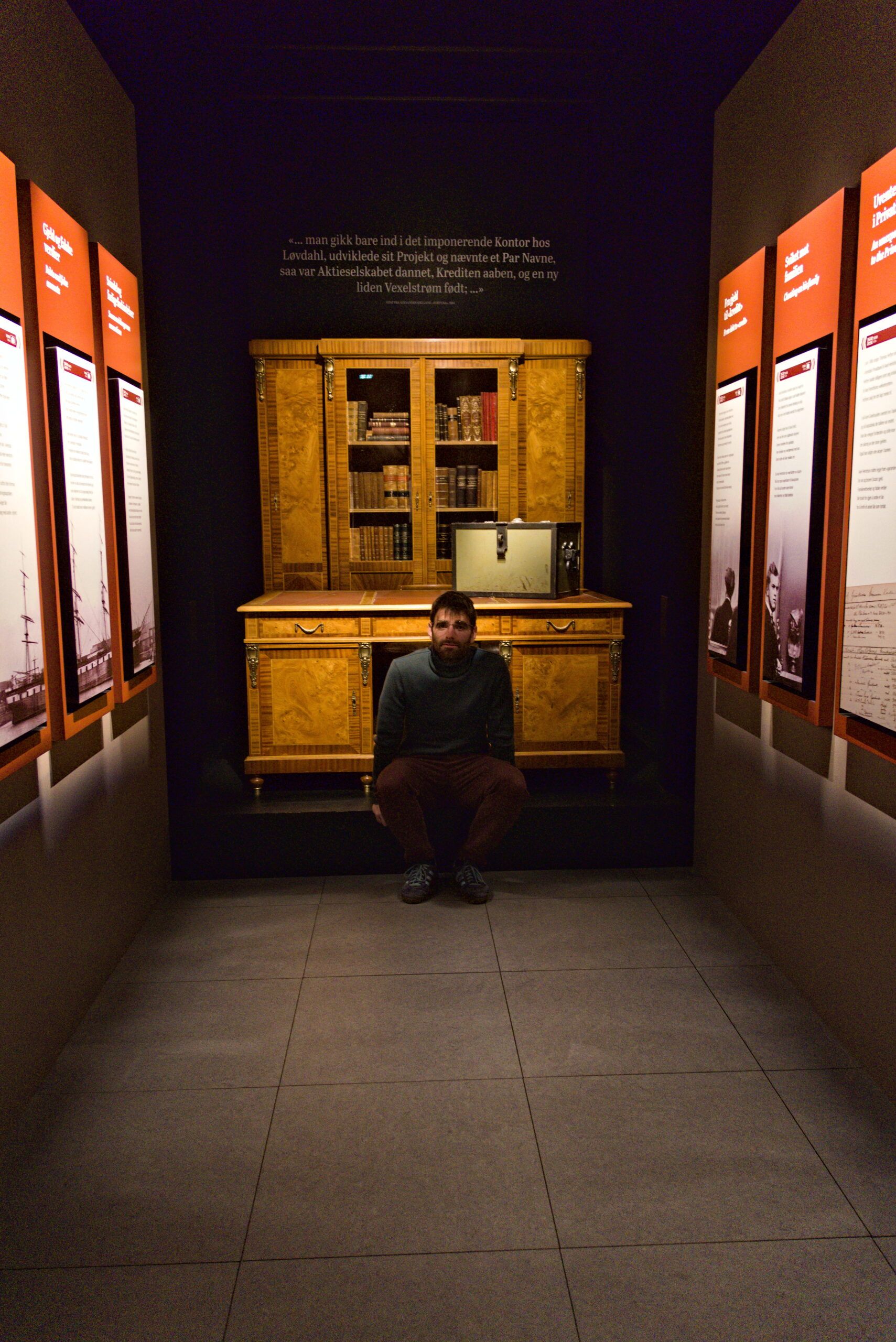
And there has certainly been plenty of discussion. Håkon and Johannes disagree on the extent to which Herlofson was responsible for the Arendal collapse. Torstveit believes that the Herlofson family bears a large part of the responsibility and points to a lack of oversight and regulations at the bank where Herlofson served as director, while Håkon believes one must view it in a broader context, with large sums invested in ships that were undergoing a rapid transition from one technology to another.
The interview is drawing to a close in the reading room at Kuben, and Håkon wraps up by explaining what *The Crash* is really about.
– At its core, it’s about people. About how entire local communities are affected when the economy collapses. About those who fall, and those who rise again.
– And I think we can learn from the crash; it shows how vulnerable we are when we put all our eggs in one basket, whether it’s sailing technology or oil technology
He looks back toward the museum.
– It’s a story about decline. But also about struggle. And about what grows from the ruins.