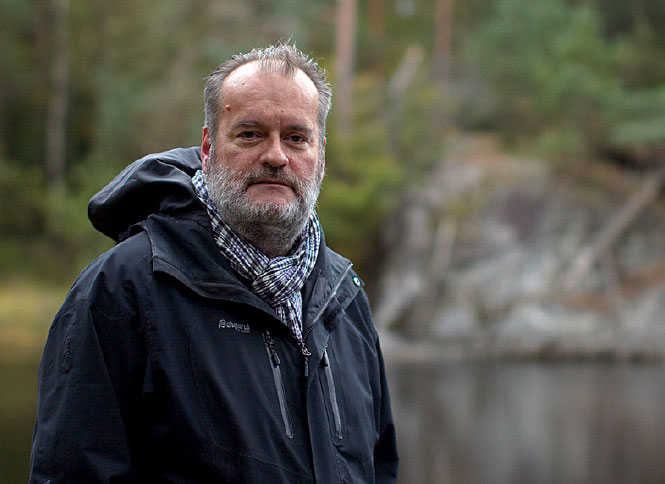
Composer and philosopher
Stig Nordhagen is eight years old when he holds his first clarinet in his hands. The place is Gjøvik, and the notes trill out of the strangetube with keys. His career as school band musician is underway. But even as a child, Stig realizes that he has a talent for more than just being one of many in an orchestra.
“I started composing music at an early age, feeling my way across the keys of an old, worn-out piano at home, and wrote my first pieces,” says the man from Gjøvik.
He began composing at an early age
The music scene in Gjøvik has always been diverse and provided him with plenty of inspiration. It became clear to Stig early on that this was what he would devote the rest of his life to.
“It never really occurred to me that not everyone involved in music also composed,” he says with a grin. “Luckily, no one told me that, so I just kept writing. I’ve also written for brass bands, even though I don’t have any particular experience as a brass player,” he says.
His musical journey took him from Toten to the Norwegian Academy of Music in Oslo. After completing his diploma studies in Norway and the Netherlands with teachers such as Ricard Kjelstrup, Tove Bratbak, and Walter Boeykens, he joined the Norwegian Armed Forces Band in Kristiansand in 1994. By then, he had already met the great
love of his life, Ingrid from Rælingen. She, too, is a clarinetist.
“We studied together at the conservatory and then moved to the Netherlands, where we each earned our diplomas in Rotterdam.” “Right after graduation, there was an audition here in Kristiansand; I think I was unemployed for just two days,” he says. Ingrid continued as a freelance musician for a few years, and today both are employed as clarinetists with the Kristiansand Symphony Orchestra. He admits that there is naturally a lot of music in a family where both parents are professional musicians, but so far the children have not chosen the same career path as their mother and father.
“We do play a few duets now and then, but it’s not like we play the clarinet around the clock. It’s our job, after all, so we fill our lives with other things,” he chuckles. For Stig, that means, among other things, long walks in the woods. It’s there that he often finds the mood and inspiration to write music.
His compositional output has become extensive. Today, Stig Nordhagen regularly receives commissions from performers and ensembles, such as for the Youth Symphony Orchestra’s 40th anniversary in 2013, Tine Thing Helseth, the Stavanger Symphony Orchestra, Eikanger-Bjørsvik Music Society, the Kristiansand Symphony Orchestra, and the European Brass Band Championships in Oslo in 2013, among others.
Nordhagen has also served as a judge at numerous championships in both brass and marching bands at the highest levels. In 2015, he was also a judge at the European Brass Band Championships in Freiburg, Germany.
“I COME UP WITH A LITTLE IDEA, MAYBE A CHORD, AND THEN MY MIND TAKES IT FROM THERE AND WORKS ON IT ON ITS OWN UNTIL IT’S READY TO BE WRITTEN DOWN”
"Traces"
In the fall of 2015, the performance “Spor” was staged with the Kristiansand Symphony Orchestra and approximately 100 high school students from Kristiansand. Stig composed the music. It is a performance in which students with disabilities and students without disabilities share the stage, where mastery, understanding, and inclusion are central themes. “Spor” was the first work Stig composed that was performed here in Kristiansand.
– Elisabeth Lindland wrote the script, but many of the lyrics were also written by the students. Whether it’s just a few lines or entire song lyrics. This serves as the foundation I use as I experiment, resulting in everything from overtures to rearrangements of pop songs, such as those by Katie Melua.
The first Spor performance was met with a standing ovation.
The reviewer for *Fædrelandsvennen* wrote, among other things: “I have experienced a performance that has deeply moved me, and I am searching for the right words to describe it. It’s so easy to shout ‘fantastic.’ But this is something much more and much more important. This is about being young, about being different, about being in or out, about being a proud person regardless of circumstances.”
– If you want to be a composer, you have to be able to do everything and master every genre. Right now, I’m writing the music for the next production of “Spor,” which will open in March 2017. We’re reusing some of the music from the previous production, but this time the theme will include the refugee crisis.
The texts I have here were written by both young refugees and young people from Kristiansand who are reflecting on their new daily lives.
Musical turning points
His compositional process begins deep within his inner world. Perhaps even deeper still.
– I come across a little something—maybe a chord—and then my mind works on it on its own until it’s ready to be written down. And the ideas often come to him when he’s out in nature.
– On the mountain road between Åndalsnes and Dombås, there’s a small body of water that flows out at both ends. I stood there pondering, delving all the way down to the molecular level and beyond. What determines whether the atoms in that single drop of water head west or east?
Where does the musical dividing line lie? As a composer, you have a thousand options; what happens when a piece of music “falls” on one particular side? One theme becomes light, another becomes dark.
In the wake of all this philosophizing, the notes tend to fall into place one by one, eventually becoming fragments of music in a digital composition program for orchestral composers. Here, he can have the program play back a perfect representation of what he has written before taking it to the orchestra, which brings the piece to life.
– It’s all about cracking the codes and asking questions. How can you combine things that don’t naturally go together?
– One of my favorite walks takes me past a small pond between Suldalen and Hellemyr, north of downtown Kristiansand. It’s called Hestefallstjønn. Here I found plenty of “raw material” for my work composing music for the European Brass Band Championships. The pieces inspired by this place have been given titles such as “Myth Forest” and “Bugs and Birds.”
Stig becomes pensive. We are at the heart of his work as a composer; the origins, the sources, the starting points. Hestefallstjønn has all the qualities needed to be a quintessentially Norwegian fairy pond. There is no view; the pond is apparently shallow, with rocks jutting up in the middle. It almost merges into a marsh, and you get the feeling that both the Nøkken and other subterranean creatures dwell here.
“I used to go for my morning runs here. I’d come by a few times a year. Sometimes in the evening. When you run here in the evening, you don’t stop for too long. You tend to start looking over your shoulder instead,” he says. The hairs on the back of our necks stand on end. We feel like we can hear the sounds coming from the pond.