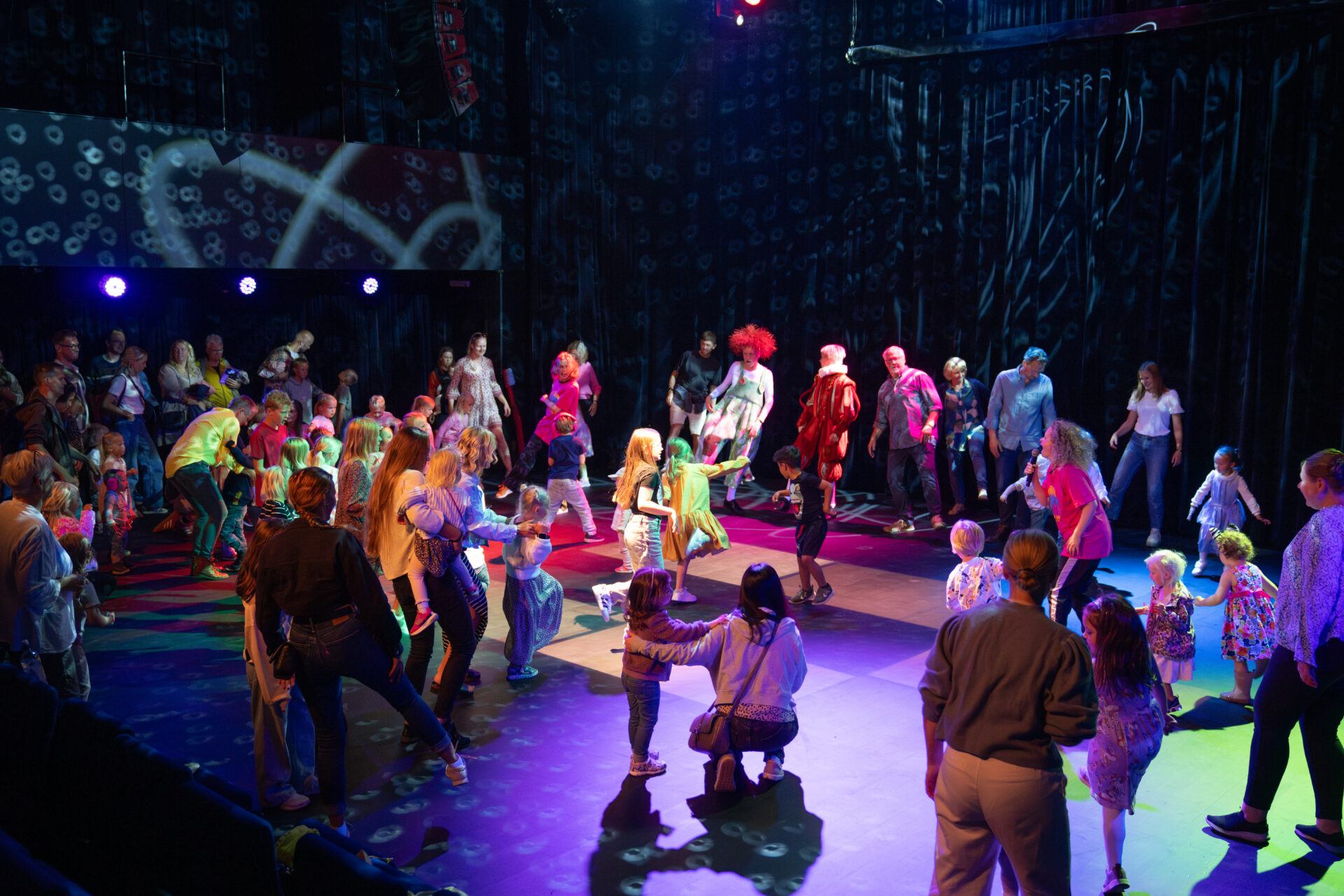
Screen time among children is decreasing. That’s good news. But less screen time doesn’t automatically lead to more play, reading, social interaction, or creative activities. If all children are to have access to experiences that build concentration and a sense of mastery, artists must be given a more prominent role in schools.
Children's ability to be creative must not be determined by their parents' financial situation
Op-ed by Eva Mari Andreassen, Head of Research at Kilden performing arts centre

The new "Ung i Oslo" survey shows that screen time among children in Oslo is declining. Among children aged 10 to 12, the percentage who spend more than three hours in front of a screen after school has fallen from 46 to 31 percent over the past five years.
It’s easy to breathe a sigh of relief. Less screen time can free up more time for sleep, rest, physical activity, play, reading, and spending time with others. Children need all of these things. But the time that’s freed up is filled in very different ways.
For some children, less screen time means more sports, marching band, dance, theater, arts classes, after-school clubs, outings, hobbies, and adults who help make these activities possible. For others, it may mean more idle time, more time alone, or more time in a local community with few activities available.
In that case, screen-free time can become a new space where the differences between children grow.
The figures from Oslo already show a clear social divide. In several eastern districts, nearly 40 percent of children spend more than three hours in front of a screen after school. This is being referred to as a new class divide. But the class divide isn’t just about screen time. It’s about what children have access to when they put the screen away.
Parents, of course, bear responsibility. But children’s daily lives are also shaped by finances, work schedules, transportation, the local community, and who knows how to get to the activities. A report from the Institute for Social Research shows that participation in cultural activities is influenced by costs, parental fees, transportation, volunteer work, facilities, and support programs. When culture becomes something families have to pay for, plan for, and drive their children to, participation becomes unevenly distributed.
Children’s opportunities to create, practice, express themselves, and feel a sense of belonging cannot be determined by their parents’ financial means, time, and social networks.
That is why we must use the setting that reaches everyone: school.
Children need more experiences where they can fully engage themselves. When children sing, play, dance, draw, write, improvise, or create something together, they use their bodies, senses, emotions, language, and attention all at the same time. They have to listen, wait, try again, find a rhythm, notice others, be noticed, and accept that things don’t always work out right away.
This is creative work. It is also a way to practice concentration, perseverance, and community.
Experts have proposed national lifestyle guidelines for concentration and attention. We already have national guidelines for physical activity, and physical activity is incorporated into the school curriculum. When something is considered important enough, we establish common guidelines and incorporate them into our community institutions.
We should do the same with creative and aesthetic activities.
A study in the British Journal of Psychology shows that children, adolescents, and adults with formal training in a musical instrument had fewer lapses in attention during tasks requiring concentration, compared to those without such training. The study alone does not prove that music training is the cause. But it points to something that many teachers, musicians, parents, and children recognize: Practicing an art form is also a form of attention training.
When children learn to play an instrument, dance, draw, write, or perform on stage, they practice listening, waiting, following a rhythm, remembering, trying again, and staying engaged in a process that takes time. At a time when many people are concerned about children’s and young people’s ability to concentrate, we should take such experiences seriously.
This is not an argument that artists should replace teachers. Many teachers are already doing a great job of fostering children’s language, physical expression, collaboration, emotions, and imagination. The problem is that schools often have too little time, too few resources, and too weak a structure to make creative work a real part of every child’s school day.
Nor does the school need more ad hoc projects that individual teachers have to carry out on their own. It needs a framework, coordination, and a committed partnership between teachers, school administrators, artists, arts schools, and local arts and cultural communities.
The Office of the Auditor Generalrecently found that an alarming number of students are leaving elementary school with weak skills in reading, writing, and arithmetic. This makes it understandable that the response is often to place greater emphasis on the core subjects. But we should also ask what kind of school day actually builds perseverance, language skills, attention, and confidence in one’s own learning.
This is also a matter of economics. The most expensive thing we do is wait until children fall behind before we take action. Social exclusion, mental health issues, a poor school environment, and a lack of coping skills come at a high cost. Yet we often view the arts and culture as something that can be cut when budgets are tight. That’s short-sighted.
Children need to be able to read, do math, and use technology. They also need to be able to concentrate over time, listen, use their senses, create, collaborate, cope with setbacks, and imagine that the world could be different from what it is.
We already have the Cultural School Bag program, cultural schools, and professional arts communities throughout the country. But these programs are often short-term, vulnerable, or dependent on local priorities. If creative experiences are to become a real part of children’s upbringing, we need to aim higher.
National guidelines on children’s time should be accompanied by a national framework for a creative childhood. All schools should have the opportunity to collaborate with arts and cultural communities. Practical and aesthetic subjects should be strengthened, and artistic approaches should be used to foster concentration, a sense of community, mastery, and learning.
Now we need to make room for the artists—along with the teachers.