In the hair
[ultimate_spacer height=»60″ height_on_tabs=»40″ height_on_mob=»40″]
“ Look, here’s how we make the bow itself,” says German bow maker Daniel Schmidt from Dresden. He holds up the slender, elegant piece of wood, carefully crafted, oiled with linseed oil, and strung with Siberian horsehair. A perfect, gentle curve gives the violin bow the distinctive look we all recognize.
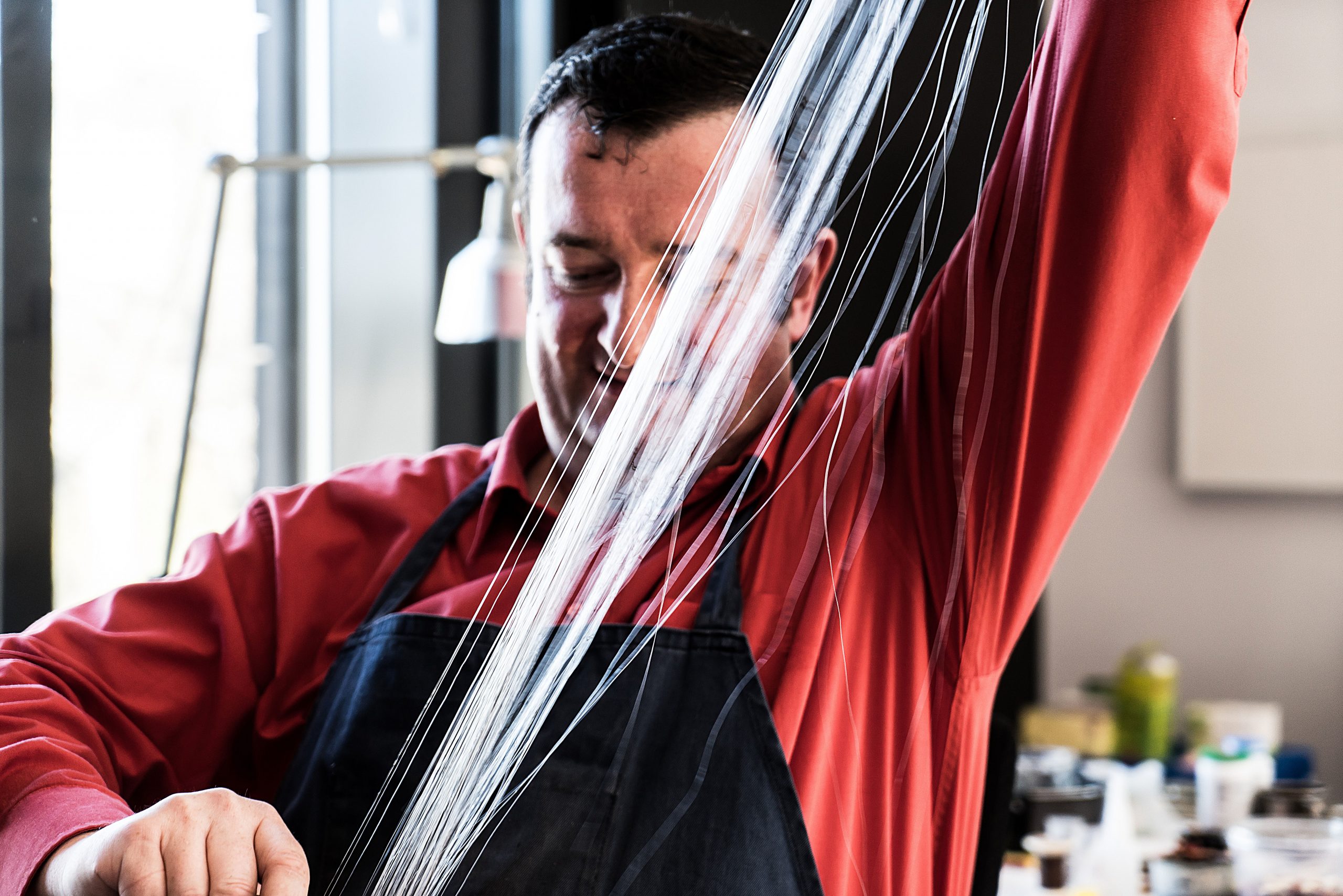
Schmidt has been brought in to clean, maintain, and restring all of the bows in the Kristiansand Symphony Orchestra. Once he has finished the job, the string players will be in the best possible position to perform at their best. He carefully aligns the bow and secures each hair one by one.
DANIEL SCHMIDT, Bowmaker for the Kristiansand Symphony Orchestra Born: 1967 in Klingenthal, Germany Winner of two gold medals at the International Bowmaking Competition in Mittlenwald.“A good piece of bow wood needs to be stored under the right conditions for about 25 years,” he says.
Trade secrets through the centuries
The wood used for string instruments’ bows comes today from the Fernambuk tree in Brazil. Bows for top-level violinists, violists, and double bassists are made exclusively from this type of wood. It is hard, strong, and flexible—it can be easily shaped by heating it in boiling water—making it ideal for its current use. The rest are closely guarded trade secrets.
“Unfortunately, I can’t give you the detailed instructions on how we craft the bow; it’s a tradition we’ve preserved in our family for centuries,” he says. “But our bows are among the best in the world.”
“A GOOD BOW IS AN INVESTMENT IN A MUSICIAN’S CAREER, AND NO TWO BOWS FEEL THE SAME,” Daniel Schmidt, bow maker.
The makeshift workshop, set up for the occasion in the Kilden office wing, smells of resin and concentration. Long strands of horsehair lie spread out across a table. Wooden blocks, jars of oil, varnish, brushes, and specialty tools are neatly arranged beside him.
“It’s best to work in daylight; artificial light isn’t good for my eyes,” explains Schmidt. He is bent over the bow of one of the symphony orchestra’s musicians. Re-stringing it is meticulous work; the right number of hairs must be used, and selecting the optimal hairs requires an experienced eye.
In high demand internationally
Schmidt himself is one of the world's most renowned bow makers. He comes from a family that has kept the craft alive for over 200 years, and six of the bows currently used by musicians in the orchestra were made by a Schmidt.
“My grandfather made two of these bows; one is mine, and the others were made by my uncle and my brother,” he says. “A good bow needs to be restrung once a year. You’re lucky to have me here,” he says with a smile.
Schmidt has worked with some of the most prestigious symphony orchestras in the world, has lectured to thousands of music students, and has been playing the violin himself since he was a child. He has won two gold medals at the International Bow-Making Competition in Mittlenwald, which is the closest thing to a world championship in this profession.
“I’m a perfectionist. My father said, ‘If you want to become a professional bow maker, you should learn to play the instrument.’ So that’s what I did. I suppose I’m not without talent,” says Schmidt, adding that he plays regularly with the university orchestra in Dresden. “I really enjoy being part of the ensemble.”
He smiles again. The profession carries great prestige, and in Germany alone there are only 50 bow makers. Only three German families are considered top-tier manufacturers, and Schmidt is one of them. Worldwide, there are no more than ten at the very highest level. It goes without saying that one must keep some things to oneself. This includes how one treats the bow hair.
– Selecting the right hairs, which come from a horse’s tail, is of course absolutely crucial to each musician’s performance. The best hairs come from Mongolia, China, and Siberia. Siberia in particular, he reveals.
A musician's investment
The finest and longest raw material is extremely expensive, particularly because of the lengthy process required before each hair finds its place on a violin bow. It is sorted, washed, counted, and treated with almost religious care. Schmidt looks around the room, picks up a bow his grandfather made, and runs his eyes along the Brazilian wood.
– A good bow is an investment in a musician’s career, and no two bows feel the same. That’s why I have to meet with each customer individually and let them try two or three first, so they can be sure they’ve found the perfect bow. Since I play in an orchestra myself, I also have firsthand knowledge of what musicians look for at every stage.
There’s a 14-year waiting list for the best bows. As mere mortals, we can probably only dream of owning a genuine Schmidt. But that’s another story.
TEXT BY AMUND HESTSVEEN
PHOTO BY TERJE SOLLIE