Big dreams
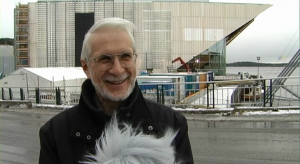
Interview with former CEO of Kilden TKS IKS Ernst Aukland
As general manager of Kilden Teater- og Konserthus for Sørlandet IKS, Ernst Aukland has spearheaded the efforts to bring the monumental construction project at Silokaia to a successful conclusion. Throughout the process, challenges have lined up, but Aukland has never doubted that the goal of creating a unique, inclusive cultural building for the entire region would be achieved.
The process towards Kilden started in 2000, when it was decided to investigate the possibility of building a concert hall at Smiths kai. Three years later, however, the city council decided to abandon these plans in favor of a new, joint building for all three artistic institutions in Kristiansand: Agder Teater, Kristiansand Symfoniorkester and Opera Sør.
- With this decision, the snowball started rolling in earnest," says Ernst Aukland, city architect in Kristiansand Municipality and Kilden's general manager since 2002. "But just as important was the fact that the city council established a new form of company, Agder Teater- og Konserthus for Sørlandet IKS, in October of the same year.
Aukland points out that without these decisions - the integration of the three institutions and the change of company form from AS to IKS - there would never have been a cultural center, at least not as we know it today:
- Firstly, the government grant of NOK 480 million was given on the condition that we went ahead with the plans to bring the professions together in one building, which was an innovation in Norwegian cultural life. Secondly, the inter-municipal company form made it possible to get a refund of VAT, which amounted to NOK 300 million.
When we know that the total cost of the Kilden project is NOK 1,290,000 (in 2003 values), it is not difficult to understand that these were crucial milestones in Kilden's history. With government support and VAT reimbursement in hand, the work of erecting the cultural building could begin in earnest.
The first thing that had to be decided was where the building should be located. It was obvious that the area at Smith's quay was too small, and after Tangen was considered, Silokaia emerged as the best alternative.
Now that the site had been chosen and the financial framework clarified, the board of the new inter-municipal company could start work. The first thing to do was to announce an architectural competition. More than 100 proposals from 25 countries were evaluated before a unanimous board of directors chose the Finnish ALA Architects' proposal in January 2005.
The following month, in February 2005, the design work could thus begin.
- "It was an extensive project," says Aukland. With such large dimensions of the building, 15,600 m2 and 130,000 m3, he emphasizes that it was necessary to spend a long time on planning; first a preliminary project that was ready in June 2007, before the main project was submitted to the city council for final approval in spring 2008.
In December of the same year, construction work on the main building could finally begin, before the entire building project was handed over to the owners in October 2011. In the meantime - July 2011 - the mergers between KSO, Opera Sør and Agder Teater had also been completed.
So it took eight years for Kilden to be completed; from the city council's decision on co-location in 2003 until the building was handed over to the owners in 2011.
- Considering the enormous dimensions we're talking about here, this is an incredibly short time. There are several reasons why it went so smoothly. One of the most important things we did was to spend a long time planning, a thorough process that saved us a lot of work later on. In addition, there were many good forces that had the necessary will and staying power to achieve the ambitious goal, which resulted in us reaching the goal both in terms of time frame and costs," says Aukland.
- "But the most important move that was made," Aukland continues, "the very prerequisite for Kilden's creation, was the ingenious move to bring the three artistic institutions together in one building, with a single management team. This formed the basis for everything that followed, and was a prerequisite for the state providing almost half a billion kroner in funding.
Ernst Aukland is confident that the innovative operating model at Kilden will continue to work well in the future, and is not afraid that the professions will start arguing among themselves.
- No, that will definitely not happen. The basic structure of the collaboration is clear since the artistic direction will still be determined by each individual institution. The new collaboration model means that everyone comes out stronger with a common program and profile that will build and preserve Kilden's position as a powerhouse for cultural life in Southern Norway - for the enjoyment and inspiration of future generations," concludes Ernst Aukland.