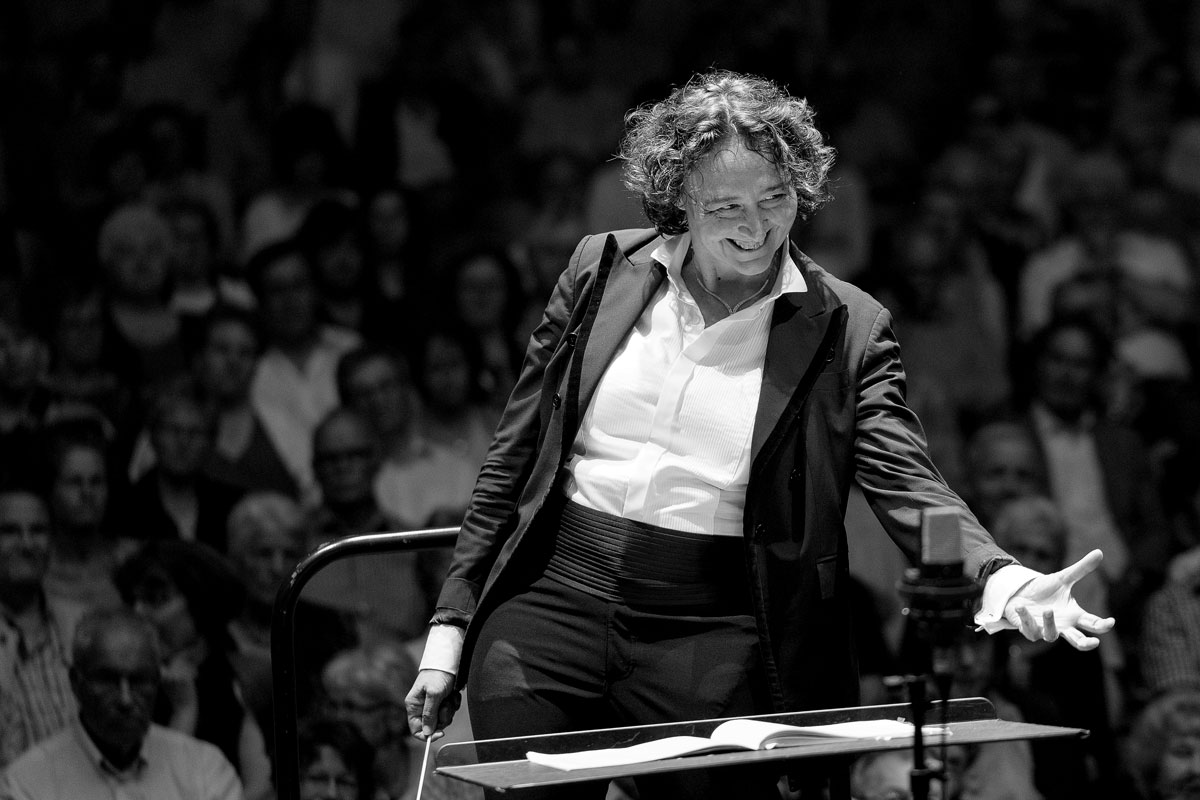
Aims to spark enthusiasm
Nathalie Stutzmann is set to become the new chief conductor of the Kristiansand Symphony Orchestra. She speaks highly of Kilden the orchestra, and plans to open rehearsals to the public.
Nathalie is the real deal. So much love, intensity, and pure technique. We need more conductors like her.
Sir Simon Rattle, outgoing chief conductor of the Berlin Philharmonic and incoming chief conductor of the London Symphony Orchestra.
“There was chemistry from the very first beat,” says French conductor Nathalie Stutzmann, who spent a week with the Kristiansand Symphony Orchestra last year. The enthusiasm has been mutual, and this has led to her appointment as the orchestra’s new chief conductor.
Conducted for the puppets
She grew up in Paris in the 1970s. Her mother and father were opera singers, and little Nathalie started playing music at an early age.
“I both sang and conducted for the puppets and toys in my room as a child,” she says, laughing contagiously. She loved both art forms and wanted to pursue both paths.
The conductor draws heavily on her long career as a renowned contralto, the deepest of the female voices in opera. Her repertoire ranges from Baroque and Romantic to modern classical music. Today she is a guest conductor for the RTE Symphony Orchestra, and she is employed as both a permanent associate conductor and singer for the São Paulo State Symphony Orchestra. She has recently made guest appearances with leading symphony orchestras in London, Philadelphia, Rotterdam, Washington, Berlin, and Stockholm. To name a few. The list is long; Stutzmann is highly sought after. She is described as one of the most talented musical personalities in the classical music world, with a solid dual strength as both a singer and a conductor.
Wasn’t Allowed to Conduct “
”
The path to becoming a conductor would turn out to be paved with conservative thorns.
She played the piano, violin, and bassoon, took singing lessons—and also wanted to study conducting.
“But it was difficult for a young girl of 13 to be recognized as a conducting student; I remember how all the boys in the class got to try their hand at it one by one. But I was never given the chance by the male teacher, and I felt incredibly mistreated,” she says.
Stutzmann gave up after a year.
– Fortunately, I had my voice.
She made her debut as an opera singer in the 1990s and has since traveled the world. This has given her the opportunity to perform under the baton of many of the world’s best conductors. She likely wouldn’t have gained that experience if she had focused exclusively on conducting.
– No young conductor would have had the same opportunities, she emphasizes.
Today she is recognized on par with her mentors, and she singles out the Finnish Jorma Panula in particular as one of her most important mentors. Later, both Simon Rattle and Seiji Ozawa. When asked what kind of conductor she herself is, and whether people today talk about authoritarian, military, or diplomatic conductors, she dismisses the whole discussion:
– If you don’t have natural authority, you’re not cut out to be a conductor. But I’m just myself when I’m with the orchestra. I think they already know that in Kristiansand, she says with a gentle laugh.
To quote Sir Simon Rattle himself, who is completing his final season as chief conductor of the Berlin Philharmonic and has just taken up a similar position with the London Symphony Orchestra: “Nathalie is the real deal. So much love, intensity, and pure technique. We need more conductors like her.”
Wildness and enthusiasm
– Music is all about instinct. It isn’t primarily an intellectual exercise, even though we spend endless hours studying the background and the score.
Stutzmann is acclaimed for her interpretations of works by Brahms, Beethoven, and Mahler, the latter representing the transition from Romanticism to modern classical music. She recently conducted a new production of Wagner’s *Tannhäuser*, to rave reviews from the international press. She herself aims to bridge the gap between the past and today’s fresh perspective on classical music.
– I always come to rehearsals well prepared, with a clear vision and conviction about the piece I’m going to conduct. The musicians do the same. Everyone knows the piece inside out; everyone knows what to play, but this is still just the foundation. I love to delve deeper, to understand what the composer is trying to say. As Mahler said: ‘You must find the substance that lies between the lines, behind the notes themselves.’ Then you need instinct and empathy, and a deep-seated urge to convey some of the original flood of emotion that the piece contains,” Nathalie says emphatically.
“You also have to draw on your own life and experiences, and bring your own feelings into it. That’s what interpretation is all about. And if you read reviews from the world premieres during the Baroque and Romantic periods, there was a great deal of joy, wildness, and enthusiasm present. I’d like to bring that back to konsertsalen,” she assures us.
A sense of humor is also an advantage. Not to mention a prerequisite.
– Humor is essential when we’re rehearsing a piece and interpreting it. I don’t take myself too seriously. We work incredibly hard, and after going through the same movement a couple dozen times, most of us start to feel the strain. That’s when it’s wonderful to rediscover that spark together, have a good laugh, and feel that positive energy turn into pure joy in the music.
Because you have to be happy and full of energy when you play, Stutzmann believes.
– Especially when we tackle melancholic and dark themes. To play sad music, you really have to be happy and lighthearted. That’s because it affects the performance.
We'll be holding open auditions where you're welcome to wear jeans and sneakers. Nathalie Stutzmann
Kristiansand next
She has found the passionate energy she is always eager to seek out in abundance with the Kristiansand Symphony Orchestra. That is also one of the reasons she immediately accepted the offer to become chief conductor.
“Kristiansand as a city must surely be extremely proud to have such a professional and talented orchestra—and a fantastic concert hall. They are ambitious in everything from technical quality to artistic expression. And Kilden the perfect facilities. All the ingredients are in place,” she says.
As a conductor, she is committed to conveying art and beauty. She hopes the city and the audience are ready for a burst of the latter. “The world needs beauty; there’s enough darkness in the world as it is,” she reminds us.
“I also love the communication we have—not just between the conductor and the orchestra, but also among the musicians themselves—and the connection with the audience. We’ll be holding open rehearsals where you’re welcome to come in jeans and sneakers. I’m looking forward to getting to know Kristiansand better,” she says, promising a rich repertoire and accomplished, renowned guest musicians.
Stutzmann feels at home anywhere—a valuable trait for a busy conductor whose work takes him all over the world.
– I’m a real foodie when it comes to experiences. I love the mountains, nature, the city, the countryside—everything. I was captivated by Kristiansand, by the views and the scent of nature, and I loved the snow. It’ll be wonderful to come back.
Text Amund Hestsveen